02 October 2006

It was a tremendous early fall weekend in the District.

OK. This place has been open for a few months now, but I finally got down there yesterday and I was amazed. The Smithsonian's American Art Museum and Portrait Gallery are really worth the trip, and they'll be even better once the special exhibitions open up so you can actually enjoy the museum as it was designed, in a square that allows you to go from end to end without having to double-back.

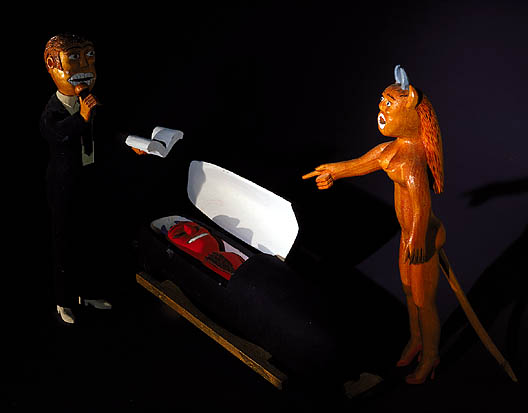
I was very impressed with the contemporary art layout -- a nice open space that doesn't seem like a warehouse (sorry, but that's how both the Baltimore Museum's contemporary area and the L.A.'s MOCA felt to me -- as much as both of those are still amazing museums). My son particularly enjoyed the folk art area, especially "Devil in a Casket with She Devil and Evangelist," pictured below:

My daughter was most impressed with the echo that her voice could make in the halls, especially if she shrieked at her highest pitch.

They've combined sculpture, painting, and furnishings in several sections that provides a very different feel from, say the National Gallery of Art's West Wing, where sculpture is mainly confined to the basement. Walking through the gilded age section, for example, provides the visitor with a chance to see several components of the aesthetic movement all at once so as to get a real sense of the "lifestyle" desired by the practitioners and patrons of the movement.

We followed that up by a trip to the fountain at the National Gallery of Art Sculpture Garden, which to my mind is the closest I've come to feeling that I'm not in DC but rather in a foreign city. It's hard to explain that sense, but perhaps it's the trees cutting off the view of the massive buildings surrounding the garden or the couples and families and friends sitting together on the benches talking or reading or just in contemplation, but there's a cloistered yet friendly feel to the place.

29 September 2006

A Date with the Father of Modern Drama.

Last night we caught Ibsen's An Enemy of the People down at the Shakespeare Theatre. After we got home, I skimmed through the play, which I hadn't read since I was in tenth grade, and was amazed at how closely the production followed Ibsen's script. However, one notable exception was in a pivotal scene in the newspaper office in which Mrs. Stockmann comes to fetch Doctor Stockmann home; whereas Ibsen's script calls for Mrs. Stockmann to stand solidly with her husband and support his fight, the production omits those lines. In fact Mrs. Stockmann becomes little other than a prop to indicate Dr. Stockmann's competing allegiances -- she and the children are bargaining chips in the town's eventual war against the good doctor.

The best thing about the play is that Ibsen takes on everyone. The conservative town fathers are shown to be concerned about nothing more than their economic bottom line. The rabble-rousing newspape editor is revealed to be nothing more than a pandering turncoat, willing to sell out his causes based on the latest popularity poll. The printer Aslaksen comes in for brutal lampooning of his "moderate" approach to everything, and as representative of the middle-class, Aslaksen is devoid of opinions other than those given him by the mayor. Even Dr. Stockmann himself comes across as obsessed with the truth to such an extent you wonder if it's really the truth he's so passsionate about or whether it's a personal desire to be right about nearly everything.

In the end, Ibsen's message resonates heavily with Nietzsche's critique of democracy in that both lament the ability of the majority -- whom they characterize as largely self-satisfied dullards -- to rule over the minority. The ruling class, the bourgeoisie, and the radicals are all corrupt, smug, and self-serving and only a very few -- what Althusser labeled "Bad Subjects" -- break from the pack.

Ibsen's play does a tremendous job of showing these power relations and how they make a mockery of high-minded ideals like truth and justice. For Dr. Stockmann, it is simply impossible that anyone could possibly act in a way that isn't in accordance with truth, and he consequently insists that he has the right on his side and that will carry the day. However, while obviously not a Marxist, Ibsen lays bare the material relations of society such that the audience understands how capital exercises its sway over society: the liberal newspaper editor sacrifices his ideals (if indeed he ever had any) to keep his paper afloat; he in turn relies on the printer, who represents the property owners, whose property values and business prospects rest on the town baths, whose board of directors has no interest in losing their capital investment over something as silly as contaminated water that's actually poisoning their patrons.

Which reminds me of the Post's so-called coverage of the aftermath of the Guatemalan Civil War, but that's another post for another day....

27 September 2006

Internal rhythms

I've come very close to the end by going back to the beginning. In other words, I've been spending a good bit of time over the past month back in the library of my undergrad school. As loopy as it sounds, I feel home there, sitting at a simple metal desk in the stacks with nothing but books and papers and now a laptop around me. I spent a good deal of my time as an undergrad in the library, either studying or just reading whatever looked interesting in the current periodicals section.

That of course was back before the day of teh internets, when you couldn't get any newspaper you wanted on-line and you actually had to be in the library to look at the catalog (it wasn't "online" back then -- it was "electronic"). So I've done some good work there, and the library has a gajillion books (actually roughly 5 million), which makes it a great place to find the last-minute resources. However, the real reason I go there instead of the much closer and more impressive Library of Congress is that up there I have babysitting (as in "Hey, Mom and Dad, wouldn't you love to see your grandkids this weekend?"). As my wife is feverishly working toward her own disseration deadline, it's not really possible for her to watch them, either. Note to self and others: you have a hell of a lot more disposable time when you don't have kids.

Anyway, I thought a little bit about how it was that in the last few weekends I've managed to write as many pages as I've written in the past year. One answer is simple: I've spent more time on it recently. However, I'd say another answer is that writing is a deeply personal and reclusive activity. No matter where you write, whether in a cafe, in a library, in a locked room, or out in a field, you don't really want to be disturbed: you want to be inside your head, forgetting as much as you can the world around you.

When I return to that library and sit in a hard-backed wooden chair with a stack of books in front of me, I can essentially forget where I am, much like a person listening to familiar music "forgets" what they're hearing -- it becomes part of the background (and it's for that reason that if I listen to music while writing, I can only listen to something I've already internalized).

The challenge sometimes is finding or creating that space where we forget ourselves.

25 September 2006

A large amount of light finally rushes in...

So let me tell you a little bit about my dissertation. I started in the PhD program in 1995. Yes. Eleven years ago. A little bit of this, a little bit of that, and all of a sudden I'm married, not so interested in writing the dissertation, then a wee bit later a kid, not so interested in writing the dissertation, not so much time free anyway, oh yeah and feeling a bit older and detached from the whole life of the academy.

I love, by the way, the life of the academy.

The point is that between 1998 and 2004 I sort of went to sleep academically. Now it's late 2006 and I'm pretty much awake and not only that I can see the end, and damn it looks good. This week I turn in the final chapter and barring any major requests for changes, it's into the final stretch, which is putting it all together and writing a little introduction...sort of like putting the garnish on the plate.

Then I will refuse to respond to anyone who doesn't address me as "Doctor."

22 September 2006

Democrats are morons.

Sure they probably think it's politically expedient to condemn Hugo Chavez for telling the truth about Bush at the UN earlier this week, but the Democrats are tripping over themselves in their rush to defend the worst President ever and showing once again why they lost the House and Senate and failed to displace an utter empty shell of a man from the Oval Office in 2004.

So they may not like the fact that the message came from a one-time coup leader and current elected -- yes, elected -- president of a foreign country, but there's no sense in looking like a bunch of idiots when even the members of his own party aren't exactly running out there to complain about it. Nancy Pelosi, so-called leader of the House Democrats, opined that Chavez was nothing but "an everyday thug." You'd wish she'd be that blunt in her criticism of Bush, who unlike Chavez did not win a large majority of the vote and whose policies have undoubtedly led to increased global tension.

Chavez may have a bit of a bone to pick here, since he overcame the US backed coup in his country in 2002. In my book, backing a coup against a foreign leader is a bit more greasy and underhanded than coming to the United Nations and insulting a foreign leader. In fact, I'd say that supporting a coup against a democratically elected leader is a better example of thuggish behavior than making a speech in the UN.

I long for the days of an oppositional party in the US.

20 September 2006

RIP: Joe Glazer

Joe Glazer, an icon of labor and protest music, has passed away. He lived in nearby Chevy Chase. Glazer turned familiar tunes into labor classics such as "We Shall Not Be Moved," and the flexibility of that song arose from one of Glazer's pillars of songwriting that the song should be easily modified to suit the occasion:
On the lines and at union rallies, particularly in the Bible Belt, he heard the tunes of traditional Christian hymns converted into labor anthems just by substituting a few lyrics. "We are climbing Jacob's ladder" became "We are building a strong union," for example. "Jesus is my captain, I shall not be moved" became "The union is behind us, we shall not be moved."
In his memoir, Mr. Glazer described leading the strikers around a giant Pepperell textile mill singing those songs. They were "basically one-line verses that could be quickly changed" to suit any situation, he said.

Glazer and other performers like him were part of a labor culture that is sadly lacking in the United States these days. In the early to mid-twentieth century, union halls were social spaces, with education programs and cultural events provided by and for the members.

Joe Glazer followed in the footsteps of Joe Hill and Ella May Wiggins (who was killed by vigilantes in the Gastonia Strike of 1929) and Woody Guthrie (whose later career overlapped Glazer's early career) and was a contemporary of Pete Seeger (who is amazingly still with us!).

In the words of Joe Hill, "Don't waste any time mourning. Organize!"