14 October 2008

Talk about burying the lead...

The Washington Post has this bombshell of an article on their website. The headline reads "U.S. Forces Nine Major Banks To Accept Partial Nationalization," which is pretty amazing. Here's the first paragraph:

The U.S. government is dramatically escalating its response to the financial crisis by planning to invest $250 billion in the country's banks, forcing nine of the largest to accept a Treasury stake in what amounts to a partial nationalization.

Throughout the rest of the article, which spans three pages on the web, you might think you'd find out which banks are being "partially nationalized." But you'd be wrong.

What kind of hack reporting is this?

Note: not liberal or conservative reporting...just plain bad reporting.

Sports, for a change of pace.

I'm getting kind of sick of hearing about how tough the SEC and Big 12 are. For starters, the Big 12 is a joke of a conference. Texas v. Oklahoma was supposed to be a major game, but these two teams have combined to beat a who's who of Palookaville. Excluding Oklahoma, here's a list of the powerhouse teams Texas has beaten this year: Florida Atlantic, UTEP, Rice, Arkansas, and Colorado. Those teams' combined record? 12-17. As for Oklahoma, they ascended to #1 whooping it up on teams like Chattanooga (?), Cincinnati, Washington, TCU, and Baylor -- a sorry group that might seem a bit more respectable at 15-16, until you realize that TCU (6-1) has played only one team from a major conference, and that was Stanford.

Also in the Big 12, Missouri supposedly was good, but Missouri has exactly 1 win against a decent team (Illinois), and that win is getting less respectable with each Illini loss. South East Missouri State? Nevada? Buffalo?

Now why are all the columnists ragging PSU about its schedule? Sure it hasn't been stellar, but I'm not seeing anything in the Big 12 that looks as good, let alone better.

As for the SEC, lately we've been told by the ESPN talking heads that the SEC is too good for its own good, that it cannibalizes its teams through the season, etc. Just because crappy conference teams are beating the good conference teams does not mean the conference is difficult; it means the quality of play is inconsistent. That's true of nearly all conferences. Auburn, which was supposed to be so damn good according to the pundits, is a colossal flop. Tuberville most likely is done after this season. LSU was revealed to be a paper tiger (though we're talking cardstock, not tissue paper) by Florida this weekend. Perennially overrated Tennessee has at last sunk into utter incompetence. Only Alabama remains, and they've not been tested except by Georgia (Georgia failed that test miserably); they're not likely to play another halfway decent team until they play LSU.

When Big 10 teams beat each other up, it's because the conference is weak; when SEC teams do it, it's because the conference is strong.

Make no mistake, the Big 10 is down this year, yes indeed. Michigan lost to Toledo at home. Toledo. In the Big House. Ohio State, in the midst of running through its schedule of teensy tiny schools in Ohio, got pounded on national television by USC. Only one Big 10 team remains unbeaten, and that's Penn State. I can't defend the strength of schedule with Coastal Carolina, Syracuse, and Temple on the schedule, but my point is not so much that PSU's opponents are so much tougher, but rather they're on par with the so-called "tough conference" leaders. Penn State's victims are a combined pathetic 17-27, so there's no gloating there.

I'm not happy with the Big 10 this year; they should be pounding non-conference opponents, at least the ones who are from little baby conferences. However, you've got losses to Utah, Toledo, and Notre Dame from Michigan; to Notre Dame from Purdue; to Ball State from Indiana.

I don't care that Ball State is ranked at this time; a Big 10 team should not lose to Ball State.

That being said, here are a few predictions:
1. Alabama will lose to LSU.
2. Texas will not lose to Missouri; they'll lost to Oklahoma State.
3. Notre Dame will go 7-5 and be invited to a BCS bowl, where they'll get their overmatched asses handed to them.

4. Florida will win the SEC.

5. Missouri and Oklahoma State will play each other for the Big 12 title.

6. Penn State will win the Big 10.

7. USC will win the PAC-10.

8. No other conferences matter. BYU will get waxed in their bowl game, which will be the first time they play a decent team.

by the way...Penn State's two national championships? Playing as an independent, the Lions suffered through years of complaints of "weak schedules" etc to beat Georgia and heisman winner Hershel Walker in 1982 and Miami and heisman winner Vinny Testaverde in 1986.


12 October 2008

Scenes of Eternal Depression

As I've stated before, I'm pretty old. Old enough to remember when people didn't shop at malls; they went to this place that was called "downtown." I remember my parents stuffing us in the car and driving to a place called Altoona, because that was the big urban center in the area (a whopping 60,000 people or so; less now) and therefore had the largest downtown. Then sometime in the mid-1970's the Logan Valley Mall became the dominant shopping area. And slowly downtown emptied out first of shoppers then of businesses.
The Kaufman's store located on the left of the photos is not related to the Kaufmann's department store chain that is now part of Macy's empire and along with Hecht's lost its individual identity to the Macy's brand. Incidentally, the Kaufman's building no longer exists; it was demolished a year ago. The large brown-brick building in the distance at center was a huge department store named Gable's, which was the centerpiece of the downtown.

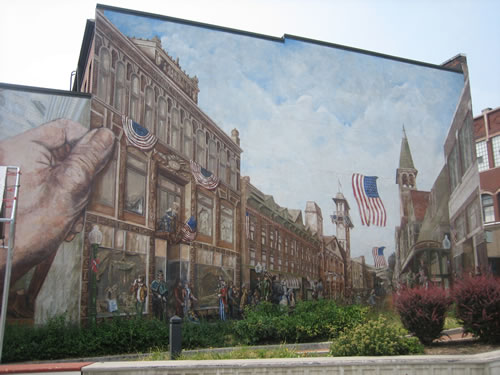
Altoona's downtown is one block from the railroad tracks. In the heyday of the Pennsylvania Rail Road, Altoona was an important stop, mainly as a center for car repair and engine building shops. There's a railroad museum across the tracks from the downtown, next to the more or less moribund Station Mall, a small one-story mall that never could compete with the larger Logan Valley Mall and perhaps never intended to, as it was anchored at its high point by a grocery store and a Hills Department Store (think of a K-Mart before they launched the Super K or Giant K or whatever). As with most rail towns, Altoona has seen its high mark receding into the distant past, but it clings furiously to the memory. The downtown is plastered with murals and posters depicting the glory that was the railroad.

The one above is an older one that was done while the downtown still had some shops and shoppers roaming around in it. As the downtown has become ever more desolate, the murals have become more ambitious, compensating for the fact that the lifestyle they allude to is gone forever, if it ever existed before anyway:


The downtown is currently full of empty storefronts with great historic (and some not so historic) bones. The train still stops twice a day -- once going east, once going west -- and the station -- which also doubles as the bus terminal -- is at least more permanent than the trailer that sat next to the tracks when my family boarded the train for an Arizona vacation in 1979.

I long for a liberal media...

Ever since the good old days of Nixon, the Right has pounced on the concept that we have a "liberal media." As evidence of such, they point to the Watergate investigation (apparently breaking and entering, diverting campaign funds to criminal activities, exerting executive power to cover up wrongdoing, and basically running a criminal organization from the Oval Office are OK; it's reporting on them that's wrong), Vietnam War coverage, media reports of Ronald Reagan's attempts to get ketchup labelled a vegetable, Dan Rather, CNN, PBS, NPR, the New York Times (and most newspapers in general), coverage of Bush's lies on Iraq, etc. Basically any news that sheds critical light on a Republican policy or action becomes evidence of "liberal bias."

As a term, "liberal media" is so pervasive that any neocon can conjure up a defense and a counter-attack all at once simply by uttering it. It's nearly as powerful as the term "soft on communism" was in the 1950's and 1960's. The latest development in this whole hoax is the new coinage, "Mainstream Media," or "MSM" for short. The MSM is invoked not as it properly should be, which is to differentiate it from the marginal publications out there, but rather as shorthand for both the "liberal media" and some sort of monolithic elitist conspiracy. Somehow, though, FOX News (one of the most popular television outlets), the Wall Street Journal (certainly a venerable and respected example of the print press), widely circulated tabloids like the New York Post, and the nearly inescapable stranglehold right-wingers have on talk radio don't actually count as MSM.


I honestly don't understand that contradiction, unless we are to understand "mainstream" in some context other than "popular" or "widespread."


But back to the Liberal Media. They seem to be everywhere, if you listen to any number of fearmongers on your radio dial. Ann Coulter, widely syndicated columnist for the "MSM," tells us they're everywhere. However, it's also utterly untrue that we have a "liberal media" in the USA.

It's true that liberal media outlets exist: Pacifica radio (WPFW 89.3 in the District for example), small run magazines such as The Nation, but to consider them mainstream or pervasive is nothing more than a perversion of truth. That's why I have to read The Guardian for a dose of liberal press.


Back in the run up to the Iraq Boondoggle, the so-called liberal media couldn't get enough of the Bush Kool-Aid...remember Judith Miller, disgraced reporter for the most prominent target of right-wing hate, the New York Times? Miller was so eager to promote the Bush Adventure that she didn't really give a crap about the veracity of her sources. The Washington Post nearly wore out the skins on their war drums. How about CNN, the supposedly liberal cable news outlet? They were too busy fine-tuning their war production values (ominous music, iconic graphics) to bother to investigate Bush's fabrications. This so-called "liberal media" helped Bush right along.


Personally, I don't see any way out of this utterly false discourse, because in a world in which a sizeable amount of the US electorate can believe both that Barack Obama is a Muslim AND that he's anti-American because of his Christian preacher, you don't stand much chance applying reason.

10 October 2008

Maybe Zeppo, but definitely not Karl...

If you want to see something that's either sad or funny, depending, you should google "obama marxist." It's pretty revealing. I'd been reading comments on various mainstream press articles about how Obama was some sort of liberal or even worse radical Marxist, and I kept thinking to myself that I didn't know a single Democrat in the House or Senate who could come close to being a Marxist. In fact, my main criticism of Obama is that he is simply more of the same neo-liberal pro-corporate fluff served up by the Democrats for decades.

Yet there seems to be a widespread belief among conservatives that Barack Obama is a Marxist. I would show examples, but I don't link to right-wing blogs as a general rule. Just do the google search, you'll see them. The fact that most of these sites also make a point of emphasizing Obama's middle name (I don't even know John McCain's middle name...) shows their hands a bit too clearly, though...and illogically of course, because there aren't too many Muslim states that are Marxist. In fact, one of the first things that generally happens to Marxists in a Muslim state is that they get thrown into prison. So I'm not sure of the connection.

Then I saw in a funny piece Dana Milbank did at the McCain/Palin rally at Lehigh University a few of the McCain/Palin supporters wearing these identical shirts that took Obama's campaign symbol (you know, that blue circle above the red and white stripes...the thing that looks an awful lot like Bank of America's corporate logo) and in the circle they had a hammer and sickle. Now where the hell does all this "Obama-as-Communist" thinking come from (I've yet to see a similar McCain logo redo with a swastika in place of the star, but maybe that's coming)? It certainly can't come from an examination of his policies or voting record in the Senate.

Unless of course you count the recent bailout bill that both he and McCain supported, since it strongly suggests that the U.S. Government will at least partially nationalize several financial institutions...but that plan was presented by the Republican administration and can hardly be said to belong to Comrade Obama.

The tax plan that Obama has been touting is hardly a new thing...it's simply a continuation of the progressive tax system that's been in effect in the United States for basically the entire 20th century and in weakened form in the 21st.

Where are Obama's plans to seize the means of production? I have yet to see his plans to nationalize private property...maybe he's being coy.

If Obama is the poster-boy of Marxism, then we Marxists are in serious trouble.

09 October 2008

Who's writing the writing that will define our time?

Every now and then, a writer or writers come along who become representative for their time. Sometimes that designation fades, sometimes it doesn't. Sometimes the top authors of their time, authors whom everyone thought would be instantly eternalized as symbols of an era, fade into the out of print or at least obscure netherworld of the literary imagination.

I can think of a few writers in that latter category, like James T. Farrell. Farrell had a long and productive literary career that began and peaked in the 1930's. His Studs Lonigan Trilogy was required reading in college English courses in the 1950's and 1960's. These days, you probably won't find a Farrell book on the syllabus for anything other than an upper level or graduate course dedicated to the 1930's or Social Realism.

On the other hand, it's pretty easy to identify authors who have stuck evocatively to their times, at least after half a century has passed. F. Scott Fitzgerald comes to mind immediately. Jack Kerouac. Jane Austen. I'd argue for Steinbeck as well. This exercise could continue: Edith Wharton, E.M. Forster, Chucky Dickens.

It's immeasurably harder to identify these writers in our times, in part because it's harder to tell who will last and who will be a mere flash in the pan. It's also harder to tell because very few authors do get designated as top of the pile representatives of their time. Faulkner for instance remains an immensely respected author, but I would suspect that no one reads him because they identify him so closely with the 1920's or 1930's. Zora Neale Hurston's output doesn't establish her as the voice of the 1930's rural South either.

Again, this isn't about great writers, favorite authors, etc. It's about figuring out who has written the literature that will be understood in the future to be about the latest fin-de-siecle. I mean, I absolutely adore Jeanette Winterson's work, but will those texts be the touchstone for the late 1980's and 1990's UK?

So I'm asking, who is evoking our era (considered roughly as 1990-present, exceptions allowed) in ways that are not only extremely powerful now, but also likely to continue to retain that power for future generations?

I'd be proud to count Bill Ayers as a co-worker.

Hell, I'd even be proud to number him among my friends, if of course we had ever crossed paths or had to work together in those ways that would draw us together as friends, which we haven't. I've never met the man in real life or fake life, and even if I had in fake life, I haven't yet devalued friendship to the point that I consider something like a facebook contact or knowing someone's name equivalent to being a "friend."

Ayers was a leader of the Weather Underground (aka the WUO, aka The Weathermen -- don't get on my case about the name changes and timeframe, ok), an organization that carried out symbolic bombings against property -- the key point that all reports on the WUO seem to leave out is that the WUO took great pains to ensure that their bombings did not cause physical harm to living people. In fact, the only three people to die from WUO bombs were WUO members. They were not carpetbombing civilians in Cambodia. They were not firing on unarmed college students.

What do you do to stop a war? Do you try non-violence only? Or do you go with Malcolm X's dictum of "by any means necessary"? In the face of continued oppressive violence -- when it's obvious that you are functioning within an economy of violence -- does it not make sense at some level to respond in a way that "brings the war home" as the Weathermen (and SDS) put it?

The answer, for me, is maybe. It's not an absolute; you have to contextualize, historicize. That's exactly what Thoreau did between his widely-known essay "Resistance to Civil Government" (1849) and his lesser-known and later "A Plea for Captain John Brown" (1859).

In the former essay, Thoreau is committed to what we understand as traditional non-violent means:

Cast your whole vote, not a strip of paper merely, but your whole influence. A minority is powerless while it conforms to the majority; it is not even a minority then; but it is irresistible when it clogs by its whole weight. If the alternative is to keep all just men in prison, or give up war and slavery, the State will not hesitate which to choose.
In fact, he calls this resistance a "peaceable revolution." Yet as a decade rolls on and it seems that the state has no interest in stopping slavery -- as slavery seems destined to roll through the newly acquired territories -- Thoreau changes his tune. In his impassioned response to John Brown's failed raid on the federal arsenal at Harper's Ferry, for which John Brown and his Black and white comrades were condemned to die, Thoreau makes clear that there are limits to non-violent responses:


It was his peculiar doctrine that a man has a perfect right to interfere by force with the slaveholder, in order to rescue the slave. I agree with him. They who are continually shocked by slavery have some right to be shocked by the violent death of the slaveholder, but no others. Such will be more shocked by his life than by his death. I shall not be forward to think him mistaken in his method who quickest succeeds to liberate the slave.
Thoreau is clearly advocating intervention "by force" on the side of abolition. Furthermore, he makes clear throughout the essay that a government that countenances the violence of slavery should be met with violent resistance. Does this make Thoreau a terrorist sympathizer? Or is Thoreau simply following true to the doctrine that some Americans subscribe to that holds that "when a long train of abuses and usurpations, pursuing invariably the same Object evinces a design to reduce them under absolute Despotism it is their right, it is their duty, to throw off such Government."

Again, there's nothing universal about it -- it's situational (I mean the document discusses a pattern that "evinces a design to reduce them under absolute despotism," not the actual reduction to a state of absolute despotism -- there's plenty of room for judgement calls), and I'd argue that in the face of the overwhelming unethical violence of chemical warfare, carpet bombing, and domestic assassination, it's utterly hypocritical to judge symbolicly placed, non-injurious bombings on the level of terrorism.

That stance does not open the door to defending every newspaper kiosk thrown through a Starbucks window or the assassination of executives of companies whose hired help executes labor activists.