As a society we used to believe that education was an important component to maintaining the republic. Thomas Jefferson certainly believed that when he wrote to Charles Yancey, "If a nation expects to be ignorant and free, in a state of
civilization, it expects what never was and never will be." [1] The push for compulsory education in the U.S. arose from a belief that some education -- at least at the elementary level -- was necessary to secure the continued survival of the nation. The establishment of compulsory education has been maintained, despite the wailings of the right wing, through court decisions resting on the right of the state to secure the general welfare of its citizens.
In so far as schooling creates docile bodies, the right wing has come around to accepting universal compulsory education. However, the right wing has never been interested in the emancipatory power of education, bemoaning (a la Glenn Beck) the supposedly horrible fact that education does not seem to to reinforce their narrow definitions of patriotism, nationalism, or "American ideals." Despite their insistence on individual rights, the right wing has a great fear of individualistic thinking; theirs is the individualism of make-believe atomistic production and consumption, a fantasy land in which you or I simply float in isolating ether until we enter into contracts with one another.
Education at every level has been under assault by the right wing for at least thirty years (dated from the landmark scare tract A Nation at Risk which yeah I know is only 28 years ago but I'm rounding up), and while most of these scary myths have been promulgated ignorantly or dishonestly by those who fail to understand that the US tests every child while many other countries test only those who have already tested into rigorous academic-tracked schools, we as a nation still seem to swallow those lies hook, line, and sinker.
We have allowed the penny wise and pound foolish to control the national imagination where it comes to education, substituting job training for critical thinking. As we advance memorization of rules and procedures and denigrate problem solving, we train students for the next five years and leave them more or less on their own for the following thirty or forty. Or fewer if they happened to have been trained in a field that is easily shipped offshore in service of capital.
At the same time the right wing has sought to dismantle education, they have been aided and abetted (sometimes actively and sometimes simply by lucky chance) by the transformation of (visual) news providers into entertainment centers. Whereas the depth and breadth of your news organization used to signal prestige if not profit, now entire cable channels are built around nothing other than the presentation of news as the sole profit generator. The era of infotainment has been particularly destructive to our nation's ability to think critically, as the lives of the Kardashians assumes preeminence over the upheavals in the Middle East. Even when world events are presented in death, they are given the infotainment treatment with slick graphics and theme songs that transform them into Baudrillardian events. The emphasis is not on informing viewers, but on keeping viewers.
Recognizing that most people get their news from television and that the format doesn't allow for deep analysis or even a moment's reflection, and understanding that the media's ostensible commitment to objectivity has for the last few decades most often meant that even outright lies will be reported unchallenged, demagogues such as House Speaker John Boehner can spout off factually incorrect statements knowing they'll reach their target audience who either don't have the background, time, or desire to question the factual content of Boehner's lies.
This post is already incredibly long, and it would take another five paragraphs to analyze the ludicrous vomit that spewed from Boehner's mouth yesterday and was given an airing even on NPR, who would certainly have challenged the Speaker had he argued that Blacks or Jews were responsible for our current economic woes. However, what he did say was just as empirically incorrect and blindly bigoted as those statements, suggesting that businesses (or to use the preferred Republican nomenclature, "job creators") were shackled by onerous taxes...when businesses currently enjoy their most favorable conditions since the gilded age.
I suppose I'll stop here. I sense my blood pressure rising, and as disgusted as I am with the cynical content of Speaker Boehner's lies and the media's lapdog consumption of them, I am even more disgusted that a significant portion of Americans are unable to see this venomous fraud for what he is.
Showing posts with label consumer culture. Show all posts
Showing posts with label consumer culture. Show all posts
16 September 2011

03 August 2011
Decline and fall.
It was 30 years ago this week that MTV started broadcasting. For those who don't remember, MTV stood for Music Television and it broadcast these things called music videos. It did this all day and all night. There were hosts called "VJs," for "video jockeys," who told viewers about the videos and the artists before or after the station played them. The whole thing was modeled on music-format radio.
Back in those days, MTV played a variety of artists, which didn't include rap or country. Once videos as a concept became more acceptable, videos became more sophisticated. Some of them received preambles to set the mood before the music actually began. Videos that consisted simply of live footage of a band became less frequent or developed a storyline of sorts (see Bruce Springsteen's "Dancing in the Dark"). Finally, we arrived at the overblown production of Michael Jackson's "Thriller," a founding moment in which videos aspired to be something other than a visual rendering of a song. "Thriller" was a mini-movie, made all the more unbearable because its popularity meant it was on several times a day, eating up a good sixth of an hour every time it aired.
With no serious rivals, MTV consolidated its grip by offering niche shows, such as Yo! MTV Raps and 120 Minutes and the Headbangers Ball. In my opinion, 120 minutes soon became the only time it was worth it to watch MTV.
Then MTV started offering original programming such as game shows, expanded news, and cartoons. Reality shows soon followed. Music became less and less a part of the so-called Music Television's programming.
I have to admit that I rarely watched MTV after I was in high school/college, and when in high school I never watched it home because we didn't have that cable package, so my depth of personal knowledge and experience with MTV ends about a decade into its existence, with the last two decades of its life being categorized as occasional viewing. I know for instance that in the first Real World (I think) there was that annoying bike messenger named Puck and some guy with AIDS and some brunette who wore stupid clothes. However, I can't tell you how many Real Worlds there were.
The channel is clearly aimed at the young, and to an extent it's hilarious to hear people like me, people in their forties and/or late thirties, complaining about the format of a channel that's so clearly geared toward teenagers to early twenty-somethings. No one is stopping a rival from coming in to fill the gap left by MTV's abandoning of music videos.
Most of the people complaining about MTV's decline are probably people like me who complained bitterly back in the day about the crappy quality of the music that MTV did play. I hated almost all of the artists we associate with MTV-friendliness: Michael Jackson and Madonna first and foremost. MTV in its music phase was essentially a top 40 station that deigned to play outside its format on occasion.
It's really hard to measure decline when you're constantly running into references to its latter day output, from Jackass to Jersey Shore.
So MTV isn't what it was 30 years ago. So what?
Back in those days, MTV played a variety of artists, which didn't include rap or country. Once videos as a concept became more acceptable, videos became more sophisticated. Some of them received preambles to set the mood before the music actually began. Videos that consisted simply of live footage of a band became less frequent or developed a storyline of sorts (see Bruce Springsteen's "Dancing in the Dark"). Finally, we arrived at the overblown production of Michael Jackson's "Thriller," a founding moment in which videos aspired to be something other than a visual rendering of a song. "Thriller" was a mini-movie, made all the more unbearable because its popularity meant it was on several times a day, eating up a good sixth of an hour every time it aired.
With no serious rivals, MTV consolidated its grip by offering niche shows, such as Yo! MTV Raps and 120 Minutes and the Headbangers Ball. In my opinion, 120 minutes soon became the only time it was worth it to watch MTV.
Then MTV started offering original programming such as game shows, expanded news, and cartoons. Reality shows soon followed. Music became less and less a part of the so-called Music Television's programming.
I have to admit that I rarely watched MTV after I was in high school/college, and when in high school I never watched it home because we didn't have that cable package, so my depth of personal knowledge and experience with MTV ends about a decade into its existence, with the last two decades of its life being categorized as occasional viewing. I know for instance that in the first Real World (I think) there was that annoying bike messenger named Puck and some guy with AIDS and some brunette who wore stupid clothes. However, I can't tell you how many Real Worlds there were.
The channel is clearly aimed at the young, and to an extent it's hilarious to hear people like me, people in their forties and/or late thirties, complaining about the format of a channel that's so clearly geared toward teenagers to early twenty-somethings. No one is stopping a rival from coming in to fill the gap left by MTV's abandoning of music videos.
Most of the people complaining about MTV's decline are probably people like me who complained bitterly back in the day about the crappy quality of the music that MTV did play. I hated almost all of the artists we associate with MTV-friendliness: Michael Jackson and Madonna first and foremost. MTV in its music phase was essentially a top 40 station that deigned to play outside its format on occasion.
It's really hard to measure decline when you're constantly running into references to its latter day output, from Jackass to Jersey Shore.
So MTV isn't what it was 30 years ago. So what?
20 July 2011
Closed Borders (a follow up)
Yesterday, I wrote about the demise of the Borders Books and Music chain, but I mainly concentrated on my first encounter with what became, for a brief time, a behemoth of books.
As amazed as I was by that first encounter and the idea that it was possible to go into a huge bookstore, sit down in the philosophy section, and browse around for hours without anyone bothering you, I actually tried my best to support local booksellers.
So many of those booksellers are gone. Chapters, which had been on K Street before moving to 11th Street, had tried appealing to its customers for donations of a sort and clung to life for a few years before it had to close up. They had a tremendous selection of poetry, and every April you could I believe buy two poetry collections and get one free. Plus, I saw Brock Clarke read from his first novel, The Ordinary White Boy, one winter night in Chapters.
I mentioned Vertigo Books yesterday. They were in Dupont Circle, just south of the Circle on Connecticut Avenue before relocating to College Park, MD, in 2001. In 2009, they closed for good. Great cultural studies section and interesting authors coming to speak.
How many others? Sisterspace and Books as well as Prometheus Books on U Street. Sidney Kramer Books on I Street (Sidney's son opened up Kramerbooks and Afterwards in Dupont -- still a vibrant place...mainly because of the food and hooking up opportunities).
It's true that DC hasn't been all loss; Busboys and Poets is an addition, but I don't think anyone would argue that the bookstore component could stand on its own...the wait time for a table alone provides an impetus to purchase a book or magazine so you have something to do for the next hour.
As amazed as I was by that first encounter and the idea that it was possible to go into a huge bookstore, sit down in the philosophy section, and browse around for hours without anyone bothering you, I actually tried my best to support local booksellers.
So many of those booksellers are gone. Chapters, which had been on K Street before moving to 11th Street, had tried appealing to its customers for donations of a sort and clung to life for a few years before it had to close up. They had a tremendous selection of poetry, and every April you could I believe buy two poetry collections and get one free. Plus, I saw Brock Clarke read from his first novel, The Ordinary White Boy, one winter night in Chapters.
I mentioned Vertigo Books yesterday. They were in Dupont Circle, just south of the Circle on Connecticut Avenue before relocating to College Park, MD, in 2001. In 2009, they closed for good. Great cultural studies section and interesting authors coming to speak.
How many others? Sisterspace and Books as well as Prometheus Books on U Street. Sidney Kramer Books on I Street (Sidney's son opened up Kramerbooks and Afterwards in Dupont -- still a vibrant place...mainly because of the food and hooking up opportunities).
It's true that DC hasn't been all loss; Busboys and Poets is an addition, but I don't think anyone would argue that the bookstore component could stand on its own...the wait time for a table alone provides an impetus to purchase a book or magazine so you have something to do for the next hour.
19 July 2011
Run for the Borders.
What a short, strange trip it's been.
When I was a young lad, oh let's say 19 or 20, I had never heard of this bookstore called Borders. I was from a little town in Pennsylvania, went to a not so little school in the middle of nowhere Pennsylvania, and was pretty happy with the little bookshop that had recently expanded in the downtown area.
However, visiting friends in Washington, DC, one year in either the late 1980's or early 1990's, sometime between 1989 and 1991 let's say, my one friend told me I had to visit this place called Borders.
There was only one in the area, I think. If I recall correctly it was out in Bethesda or Friendship Heights. Back then, my knowledge of DC geography was very spotty.
I was amazed that a supermarket of books existed.
I think the largest bookstore I'd ever been in to that date was the Ollsson's on Wisconsin Avenue in Georgetown, one of the first casualties in that ill-fated local chain's demise.
Fast forward a few years, and I've moved to DC. I was a graduate student at a school in Foggy Bottom and a Borders opened up on 19th and L. It was a great place to go to kill time before or after class, and of course to buy books, although once I discovered the great local bookstores, I spent less and less time buying books at Borders.
Many of those local bookstores were done in not so much by Borders -- although they played a part -- as by Barnes and Noble, which aggressively moved into DC, and the pressures everyone faced from online retailers like Amazon. Vertigo Books in Dupont Circle was one of my favorites.
I'm pleased that Bridge Street Books in Georgetown -- my personal favorite -- continues.
So now all the Borders will be shuttered. What do we do with these hulking beasts on the periphery of our cities and towns?
When I was a young lad, oh let's say 19 or 20, I had never heard of this bookstore called Borders. I was from a little town in Pennsylvania, went to a not so little school in the middle of nowhere Pennsylvania, and was pretty happy with the little bookshop that had recently expanded in the downtown area.
However, visiting friends in Washington, DC, one year in either the late 1980's or early 1990's, sometime between 1989 and 1991 let's say, my one friend told me I had to visit this place called Borders.
There was only one in the area, I think. If I recall correctly it was out in Bethesda or Friendship Heights. Back then, my knowledge of DC geography was very spotty.
I was amazed that a supermarket of books existed.
I think the largest bookstore I'd ever been in to that date was the Ollsson's on Wisconsin Avenue in Georgetown, one of the first casualties in that ill-fated local chain's demise.
Fast forward a few years, and I've moved to DC. I was a graduate student at a school in Foggy Bottom and a Borders opened up on 19th and L. It was a great place to go to kill time before or after class, and of course to buy books, although once I discovered the great local bookstores, I spent less and less time buying books at Borders.
Many of those local bookstores were done in not so much by Borders -- although they played a part -- as by Barnes and Noble, which aggressively moved into DC, and the pressures everyone faced from online retailers like Amazon. Vertigo Books in Dupont Circle was one of my favorites.
I'm pleased that Bridge Street Books in Georgetown -- my personal favorite -- continues.
So now all the Borders will be shuttered. What do we do with these hulking beasts on the periphery of our cities and towns?
25 June 2010
Is everyone comfortable?
It's orientation day at the tiny university at which I'm currently employed. This year must be some sort of nautical theme -- as orientations are increasingly nothing more than marketing events shaped to draw the "customers" in, like all the agricultural detritus found on the walls of a Cracker Barrel -- because all the students working the orientation were wearing sailor caps.
No pirates were in sight, nor did I spot a cop, construction worker, Indian, cowboy, or leather man.
The campus bookstore, of course, was open, selling its collection of branded swag to prospective students and parents alike. Like many campus bookstores, this one sells very few books, with even the course textbook area being relegated to the back corner of the store. That section probably occupies about 1/6th the area of the store, with the other 5/6ths containing a large selection of clothing, coffee mugs, keychains, candy, and -- like the inedible sandwiches on the tables in Harry Hope's bar in The Iceman Cometh -- a few popular novels and magazines.
Other than the free lunch being provided to parents and incoming students alike, I didn't see any other actual activities of orientation, but I assume they involved a tour of the nicer buildings on campus: one dorm recently received new furniture and was probably showcased, the athletics center dates from the 1990's and is very nice for a school our size, the library is even more recent and again is a gem for a school our size, and a new classroom/office building sits in the center of campus.
They'll most likely avoid the building I work in, which is the original campus building and shows the haphazard upgrades that correspond to a university that for much of its life struggled to make the most of its space with less than abundant resources: mismatched carpet, cracked tile floors, classrooms with chairs packed so tightly the instructor finds him or herself pushed into a corner near exposed plumbing, etc. In other words, a building that doesn't look good in a college catalog but will in fact be the building that most of their classes are in.
Well, I wish them all success and hopefully we'll have a good enrollment and maybe they'll hire a new line in English (not holding my breath).
No pirates were in sight, nor did I spot a cop, construction worker, Indian, cowboy, or leather man.
The campus bookstore, of course, was open, selling its collection of branded swag to prospective students and parents alike. Like many campus bookstores, this one sells very few books, with even the course textbook area being relegated to the back corner of the store. That section probably occupies about 1/6th the area of the store, with the other 5/6ths containing a large selection of clothing, coffee mugs, keychains, candy, and -- like the inedible sandwiches on the tables in Harry Hope's bar in The Iceman Cometh -- a few popular novels and magazines.
Other than the free lunch being provided to parents and incoming students alike, I didn't see any other actual activities of orientation, but I assume they involved a tour of the nicer buildings on campus: one dorm recently received new furniture and was probably showcased, the athletics center dates from the 1990's and is very nice for a school our size, the library is even more recent and again is a gem for a school our size, and a new classroom/office building sits in the center of campus.
They'll most likely avoid the building I work in, which is the original campus building and shows the haphazard upgrades that correspond to a university that for much of its life struggled to make the most of its space with less than abundant resources: mismatched carpet, cracked tile floors, classrooms with chairs packed so tightly the instructor finds him or herself pushed into a corner near exposed plumbing, etc. In other words, a building that doesn't look good in a college catalog but will in fact be the building that most of their classes are in.
Well, I wish them all success and hopefully we'll have a good enrollment and maybe they'll hire a new line in English (not holding my breath).
08 July 2009
24/7/365
It's time to put some serious government regulation on "always on" media. That means television (network, cable, satellite), radio, and their associated streaming sites on the internet. But especially on the so-called news channels. In fact, I'm in favor of an outright ban on any stations that pretend to offer 24 hour news coverage.
You think I'm joking.
OK, I might be. But only a little.
I'll be the first to admit that I don't watch these channels. In fact, I haven't watched CNN on a regular basis since the 1st Gulf War, and I never watched Fox, MSNBC, or CNBC on a regular basis. The 1st Gulf War was really a turning point for these channels. Back then CNN was the only game in town, but that war coverage led the way in making war into entertainment. While Vietnam coverage brought the war into the living room to show its horror, the Gulf War coverage was there to show the power and the glory of technology and American military might (never mind that the US v. Iraq was basically the equivalent of an early September pre-conference football game for Penn State or Florida State).
Now before I get too Baudrillard on everyone, let me cut to the chase: the 1st Gulf War showed that it was the presentation of spectacle and not the importance or lack thereof of the object itself that mattered. It also showed that you could talk about one subject 24 hours a day if you just pretended you had different takes on it...so panels of experts appear out of nowhere, hour long pundit shows spring up to vary the delivery of the same information. And it doesn't only work for wars: the OJ Simpson chase and trial, Monica Lewinsky, etc. and now the Michael Jackson death can all be given the same treatment.
Enough is enough. Has anyone seriously reported on the G8? The length of time spent on unraveling actual stories that affect the world in a real way, like the G8 summit or Darfur or unrest in China? No, and the reason is that these stories aren't sexy. And they're dangerous. Sure war is dangerous, too, but the payoff is too great to ignore if it's a U.S. war. G8 summit coverage takes too much time, what with having to explain all the complex financial and political implications of a small cabal of industrialized nations getting together to decide how to maintain their influence. Darfur is, well, kind of dangerous, and so, well, 2008. And who wants to anger the Chinese government with coverage of internal unrest when China may decide to buy controlling interests in your news channel next year (OK, I jest on that last one, but only a little).
Complex analysis doesn't sell. You will learn more in one hour of the PBS NewsHour than you will in 24 hours of CNN or Fox. In other words, you don't need 24 hours of coverage to cover stories well, and you certainly don't need companies whose main goal is to fill 24 hours of time with about two hours worth of news (if that) fluffing stuff up like super-whipped butter on the IHOP buffet.
I'm willing to bet there's a direct correlation between how little you know about a lot of things and how much you watch cable news. And in the case of Fox, I'm willing to bet there's a direct correlation about how much you don't know and how much you watch Fox.
I think I've vented my spleen sufficiently.
You think I'm joking.
OK, I might be. But only a little.
I'll be the first to admit that I don't watch these channels. In fact, I haven't watched CNN on a regular basis since the 1st Gulf War, and I never watched Fox, MSNBC, or CNBC on a regular basis. The 1st Gulf War was really a turning point for these channels. Back then CNN was the only game in town, but that war coverage led the way in making war into entertainment. While Vietnam coverage brought the war into the living room to show its horror, the Gulf War coverage was there to show the power and the glory of technology and American military might (never mind that the US v. Iraq was basically the equivalent of an early September pre-conference football game for Penn State or Florida State).
Now before I get too Baudrillard on everyone, let me cut to the chase: the 1st Gulf War showed that it was the presentation of spectacle and not the importance or lack thereof of the object itself that mattered. It also showed that you could talk about one subject 24 hours a day if you just pretended you had different takes on it...so panels of experts appear out of nowhere, hour long pundit shows spring up to vary the delivery of the same information. And it doesn't only work for wars: the OJ Simpson chase and trial, Monica Lewinsky, etc. and now the Michael Jackson death can all be given the same treatment.
Enough is enough. Has anyone seriously reported on the G8? The length of time spent on unraveling actual stories that affect the world in a real way, like the G8 summit or Darfur or unrest in China? No, and the reason is that these stories aren't sexy. And they're dangerous. Sure war is dangerous, too, but the payoff is too great to ignore if it's a U.S. war. G8 summit coverage takes too much time, what with having to explain all the complex financial and political implications of a small cabal of industrialized nations getting together to decide how to maintain their influence. Darfur is, well, kind of dangerous, and so, well, 2008. And who wants to anger the Chinese government with coverage of internal unrest when China may decide to buy controlling interests in your news channel next year (OK, I jest on that last one, but only a little).
Complex analysis doesn't sell. You will learn more in one hour of the PBS NewsHour than you will in 24 hours of CNN or Fox. In other words, you don't need 24 hours of coverage to cover stories well, and you certainly don't need companies whose main goal is to fill 24 hours of time with about two hours worth of news (if that) fluffing stuff up like super-whipped butter on the IHOP buffet.
I'm willing to bet there's a direct correlation between how little you know about a lot of things and how much you watch cable news. And in the case of Fox, I'm willing to bet there's a direct correlation about how much you don't know and how much you watch Fox.
I think I've vented my spleen sufficiently.
25 January 2009
The short track to street cred. Or not.
I like Joe Strummer as much as the next person, but...
No, let me rephrase that. I revere Joe Strummer, but...
I would never buy this Faux Strummer guitar for nearly $1000:

Seriously. For a grand you can get a manufactured Telecaster that simulates Joe Strummer's 1975 Tele. Forget the fact that his Tele looked that way from relentless repaintings and actual road wear -- now you can buy it prefab. But the best bit (if by best you are thinking nearly throw up in your mouth) is the verbiage written to sell this distressed guitar:
So in tribute to his individuality, self-expression, and change, we're going to offer a cookie cutter replica so you can all be individuals (yes, we're all individuals...).
Seriously.
No, let me rephrase that. I revere Joe Strummer, but...
I would never buy this Faux Strummer guitar for nearly $1000:

Seriously. For a grand you can get a manufactured Telecaster that simulates Joe Strummer's 1975 Tele. Forget the fact that his Tele looked that way from relentless repaintings and actual road wear -- now you can buy it prefab. But the best bit (if by best you are thinking nearly throw up in your mouth) is the verbiage written to sell this distressed guitar:
All his life, he vigorously championed individuality, self-expression and change-tenets often reflected in the constantly altered look of his favorite instrument-his Telecaster (currently on display in the Rock and Roll Hall of Fame and Museum in Cleveland), an otherwise standard '60s-era model with all the original parts and specifications.
So in tribute to his individuality, self-expression, and change, we're going to offer a cookie cutter replica so you can all be individuals (yes, we're all individuals...).
Seriously.
29 November 2008
What we talk about when we talk about...well, what do we talk about?
I hope it all was worth it. Nothing says holiday spirit like trampling workers to death or shooting fellow shoppers. Of course, the authorities in California are trying to distance the shooting from Black Friday or an argument over a toy, but the point remains that those involved were shopping and had an argument. And someone got shot. So maybe they weren't fighting over this year's hottest hard to get item, but I'm willing to bet that they're frayed nerves and quick tempers had something to do with the consumption frenzy that generally begins around 4 a.m. on the day after Thanksgiving.
It seems to me that the main way in which we relate to other people is through consumption. We chat with the barista, we hand the valet the keys, or maybe we're on the other end of that equation. However, it goes beyond our interactions with others as server/served, producer/consumer. I think in many ways, consumption is the way many of us relate to the world. We don't know what to do when we aren't consuming. If a store is open -- even if there's nothing inside there we need -- many of us (and I'll include myself here) will go to that store just to walk around the aisles.
Maybe we'll find something we desperately need. Maybe we'll kill the hours, anyway.
It seems to me that the main way in which we relate to other people is through consumption. We chat with the barista, we hand the valet the keys, or maybe we're on the other end of that equation. However, it goes beyond our interactions with others as server/served, producer/consumer. I think in many ways, consumption is the way many of us relate to the world. We don't know what to do when we aren't consuming. If a store is open -- even if there's nothing inside there we need -- many of us (and I'll include myself here) will go to that store just to walk around the aisles.
Maybe we'll find something we desperately need. Maybe we'll kill the hours, anyway.
12 October 2008
Scenes of Eternal Depression
As I've stated before, I'm pretty old. Old enough to remember when people didn't shop at malls; they went to this place that was called "downtown." I remember my parents stuffing us in the car and driving to a place called Altoona, because that was the big urban center in the area (a whopping 60,000 people or so; less now) and therefore had the largest downtown. Then sometime in the mid-1970's the Logan Valley Mall became the dominant shopping area. And slowly downtown emptied out first of shoppers then of businesses.
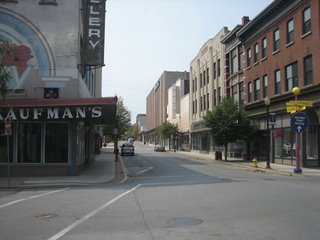 The Kaufman's store located on the left of the photos is not related to the Kaufmann's department store chain that is now part of Macy's empire and along with Hecht's lost its individual identity to the Macy's brand. Incidentally, the Kaufman's building no longer exists; it was demolished a year ago. The large brown-brick building in the distance at center was a huge department store named Gable's, which was the centerpiece of the downtown.
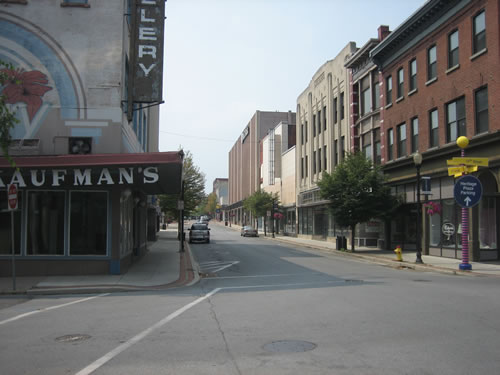 The Kaufman's store located on the left of the photos is not related to the Kaufmann's department store chain that is now part of Macy's empire and along with Hecht's lost its individual identity to the Macy's brand. Incidentally, the Kaufman's building no longer exists; it was demolished a year ago. The large brown-brick building in the distance at center was a huge department store named Gable's, which was the centerpiece of the downtown.
Altoona's downtown is one block from the railroad tracks. In the heyday of the Pennsylvania Rail Road, Altoona was an important stop, mainly as a center for car repair and engine building shops. There's a railroad museum across the tracks from the downtown, next to the more or less moribund Station Mall, a small one-story mall that never could compete with the larger Logan Valley Mall and perhaps never intended to, as it was anchored at its high point by a grocery store and a Hills Department Store (think of a K-Mart before they launched the Super K or Giant K or whatever). As with most rail towns, Altoona has seen its high mark receding into the distant past, but it clings furiously to the memory. The downtown is plastered with murals and posters depicting the glory that was the railroad.
The one above is an older one that was done while the downtown still had some shops and shoppers roaming around in it. As the downtown has become ever more desolate, the murals have become more ambitious, compensating for the fact that the lifestyle they allude to is gone forever, if it ever existed before anyway: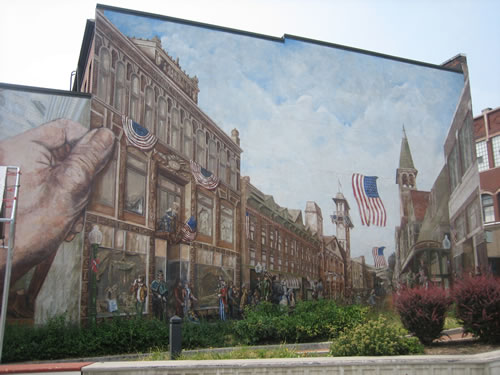
The downtown is currently full of empty storefronts with great historic (and some not so historic) bones. The train still stops twice a day -- once going east, once going west -- and the station -- which also doubles as the bus terminal -- is at least more permanent than the trailer that sat next to the tracks when my family boarded the train for an Arizona vacation in 1979.
15 September 2008
Ghost in the Graveyard
Down goes Lehman.
It's been an interesting scene for anyone following the continued fallout of the Real Estate Bubble Boondoggle, when everyone thought -- yet again -- that old rules didn't apply and this was some kind of "new economy." However, money is money, and as fanciful as the imaginary system of value is, in the end it is tied to the very real facts of securing food, clothing, and shelter. So while many of us were treating our houses like printing presses whose very wallpaper dripped greenbacks, and speculators were pretending that their fantasy-laden house flipping markups were linked to "what the market will bear," the financial system -- from mortgage brokers to the big lenders -- was somehow sniffing so much glue that they got caught up in the ridiculous shenanigans of "interest only" and "negative amortization" loans.
Borrowers borrowed on the timeworn failed notion -- easily disproven by even the most rudimentary market analysis -- that prices always go up (not in the long term, mind you, but always...) and that record-breaking housing price increases were inexplicably the new norm. An interest only loan didn't matter: your new home would appreciate 300% in five years, allowing you access to the cash; ARMs that would reset in five years wouldn't matter, because interest rates would always be low and your house would always be worth immeasurably more money.
There's always been a sucker born every minute, but banks are supposed to play the opposite role: they're supposed to limit their exposure to moronic financial schemes by refusing to lend money that isn't likely to get repaid. But Jesus Christ is was as if we were in Carnival time and nothing mattered -- everyone was making money faster than coke could be snorted in the upper floor bathrooms of Manhattan investment firms, except it wasn't really making money in the traditional sense.
In short, the false economy of the housing industry (or perhaps the real economy -- the false part was the presuppositions) had nothing to do with increasing wealth and everything to do with overextending credit, and when the bill finally came due...well, we all can see the aftermath of a bad credit binge. Except this one isn't confined to your overspending on holiday shopping and facing a few bad months in the new year.
My friends, we are seeing the logical consequences of the right-wing's near-thirty year assault on financial checks and balances, proving once again that those who do not know history are doomed to repeat it.
It's been an interesting scene for anyone following the continued fallout of the Real Estate Bubble Boondoggle, when everyone thought -- yet again -- that old rules didn't apply and this was some kind of "new economy." However, money is money, and as fanciful as the imaginary system of value is, in the end it is tied to the very real facts of securing food, clothing, and shelter. So while many of us were treating our houses like printing presses whose very wallpaper dripped greenbacks, and speculators were pretending that their fantasy-laden house flipping markups were linked to "what the market will bear," the financial system -- from mortgage brokers to the big lenders -- was somehow sniffing so much glue that they got caught up in the ridiculous shenanigans of "interest only" and "negative amortization" loans.
Borrowers borrowed on the timeworn failed notion -- easily disproven by even the most rudimentary market analysis -- that prices always go up (not in the long term, mind you, but always...) and that record-breaking housing price increases were inexplicably the new norm. An interest only loan didn't matter: your new home would appreciate 300% in five years, allowing you access to the cash; ARMs that would reset in five years wouldn't matter, because interest rates would always be low and your house would always be worth immeasurably more money.
There's always been a sucker born every minute, but banks are supposed to play the opposite role: they're supposed to limit their exposure to moronic financial schemes by refusing to lend money that isn't likely to get repaid. But Jesus Christ is was as if we were in Carnival time and nothing mattered -- everyone was making money faster than coke could be snorted in the upper floor bathrooms of Manhattan investment firms, except it wasn't really making money in the traditional sense.
In short, the false economy of the housing industry (or perhaps the real economy -- the false part was the presuppositions) had nothing to do with increasing wealth and everything to do with overextending credit, and when the bill finally came due...well, we all can see the aftermath of a bad credit binge. Except this one isn't confined to your overspending on holiday shopping and facing a few bad months in the new year.
My friends, we are seeing the logical consequences of the right-wing's near-thirty year assault on financial checks and balances, proving once again that those who do not know history are doomed to repeat it.
29 April 2008
It's called a "Jeremiad." Now get over it.
I'm absolutely sickened by the idiocy that rears its head in the United States with every election cycle, but the whole Rev. Jeremiah Wright story is so overblown and beside the point that I'm left utterly unconvinced that the U.S. any longer has the intelligence to continue as a democracy, given that the basis of a functioning democracy is a well-informed, educated electorate.
Preachers in the U.S. have a long history of using the Jeremiad form. It used to be and perhaps still is standard practice to have students in high school read Jonathan Edwards' "Sinners in the Hands of an Angry God," which dates all the way back to 1741 (and technically is a colonial rather than U.S. text, but generally it's taught in American literature). More recently, it's popped up most frequently from right-wing politico-preachers like Jerry Falwell and Pat Robertson, the latter of whom actually made a run at the Republican presidential nomination back in 1988.
While Wright argued that the September 11, 2001, attacks on the U.S. were an example of the "chickens coming home to roost," a riff no doubt inspired by Malcolm X's very accurate description of the social unrest prevalent in U.S. cities in the 1960's, Robertson -- on his wildly popular cult television broadcast -- agreed with fellow moron Falwell that 9/11 was the result of America's moral decay. In other words, God allowed the attack to punish a society that accepted the ACLU, abortionists, feminists, gays, and the People For the American Way. Not nearly as logical as Wright's argument that U.S. foreign policy caused blowback, but in the same sense a Jeremiad.
However, it would be no balm to Wright to be excused simply on the grounds that mean-spirited, hate-mongering wack-jobs like Falwell and Robertson also harshly criticize the United States. The media has been pouncing on the catchphrase, "God damn America," and has been ignoring or casting into the shadows the rhetorical contrast he was making between the jingoistic "God Bless America" with its assumption of holy approval for the nation's actions and the nation's actual actions as regards race relations. Anyone with half an ounce of honesty would have to admit that the promises of the Civil Rights era have not been completely fulfilled, what with police commanders in Washington, DC, in 2006 arguing that Georgetown and Blacks don't mix (or more recently, last year the Washington Post found evidence of racial profiling in Georgetown and Adams Morgan...the reader comments are actually more revealing than the article).
Media outlets are too self-centered and sensationalist to treat sermons for what they are: rhetoric aimed to excite and exhort the audience to probe their situations in life. I'm not much of a defender of religion, since it is primarily used as a tool of control, but even the master's tools can be turned against the system on occasion, as with Liberation Theology and Martin Luther King's appeals to the same religious tradition that one hundred years earlier was being used to justify slavery as a "christianizing influence on the heathens."
Bottom line: all I see in Wright's sermons is basic fire-and-brimstone modern-society-is-corrupt rhetoric, and I can't figure out why the hell this story has legs, except for the very cynical explanation that the media, as Don Henley once sang, "they love dirty laundry."
Preachers in the U.S. have a long history of using the Jeremiad form. It used to be and perhaps still is standard practice to have students in high school read Jonathan Edwards' "Sinners in the Hands of an Angry God," which dates all the way back to 1741 (and technically is a colonial rather than U.S. text, but generally it's taught in American literature). More recently, it's popped up most frequently from right-wing politico-preachers like Jerry Falwell and Pat Robertson, the latter of whom actually made a run at the Republican presidential nomination back in 1988.
While Wright argued that the September 11, 2001, attacks on the U.S. were an example of the "chickens coming home to roost," a riff no doubt inspired by Malcolm X's very accurate description of the social unrest prevalent in U.S. cities in the 1960's, Robertson -- on his wildly popular cult television broadcast -- agreed with fellow moron Falwell that 9/11 was the result of America's moral decay. In other words, God allowed the attack to punish a society that accepted the ACLU, abortionists, feminists, gays, and the People For the American Way. Not nearly as logical as Wright's argument that U.S. foreign policy caused blowback, but in the same sense a Jeremiad.
However, it would be no balm to Wright to be excused simply on the grounds that mean-spirited, hate-mongering wack-jobs like Falwell and Robertson also harshly criticize the United States. The media has been pouncing on the catchphrase, "God damn America," and has been ignoring or casting into the shadows the rhetorical contrast he was making between the jingoistic "God Bless America" with its assumption of holy approval for the nation's actions and the nation's actual actions as regards race relations. Anyone with half an ounce of honesty would have to admit that the promises of the Civil Rights era have not been completely fulfilled, what with police commanders in Washington, DC, in 2006 arguing that Georgetown and Blacks don't mix (or more recently, last year the Washington Post found evidence of racial profiling in Georgetown and Adams Morgan...the reader comments are actually more revealing than the article).
Media outlets are too self-centered and sensationalist to treat sermons for what they are: rhetoric aimed to excite and exhort the audience to probe their situations in life. I'm not much of a defender of religion, since it is primarily used as a tool of control, but even the master's tools can be turned against the system on occasion, as with Liberation Theology and Martin Luther King's appeals to the same religious tradition that one hundred years earlier was being used to justify slavery as a "christianizing influence on the heathens."
Bottom line: all I see in Wright's sermons is basic fire-and-brimstone modern-society-is-corrupt rhetoric, and I can't figure out why the hell this story has legs, except for the very cynical explanation that the media, as Don Henley once sang, "they love dirty laundry."
12 April 2008
So long, Buffalo.
Buffalo was a hoot. The city has beautiful bones, but unfortunately much of those bones are laid bare by the economic depression that followed the collapse of the shipping and steel industries. I suppose photos will follow once I'm fully back and functional, but in the meantime you'll have to take my word for it.
This was a business trip, or as much of a business trip as possible when you and your wife are toting along two children, so we weren't there completely to see the sights, and we spent much of the time in a hotel in downtown Buffalo.
It's extremely difficult to get a six pack of beer in downtown Buffalo. Sure you can find a bar, no problem, but try to find a six pack of beer and you'll wish you'd started sooner. While they apparently sell beer in CVS stores in New York, in downtown Buffalo if you try to go to CVS after eight p.m., you're out of luck. 8 p.m. -- What sort of CVS closes at 8 p.m.? Convenience my ass.
We settled on buying five bottles of Labatt's Blue from the hotel bar for a price that would have bought us a case with some change anywhere else.
Outside our business itinerary, we squeezed in a trip to Niagara Falls, both American and Canadian sides, and were amazed both at the beauty of the falls and the utter tastelessness of the detritus that has sprung up around the falls. In a show of extremely bad taste, some geniuses have lit the falls at night with multi-colored lights, turning a natural wonder into a monument to human mismanagement.
We had a minor incident returning from Canada, because we didn't have passports or birth certificates on hand for our children. We'd forgotten that ever since the US broke diplomatic relations with the barbarians to the north, it's been a tense border situation. After hinting that perhaps we were smuggling in Canadian style Manchurian Candidates who would eventually grow up, take powerful positions within the US government, and betray us to the Canadians -- or at least make us go metric -- he let us through.
More on the Canadian bits later...
This was a business trip, or as much of a business trip as possible when you and your wife are toting along two children, so we weren't there completely to see the sights, and we spent much of the time in a hotel in downtown Buffalo.
It's extremely difficult to get a six pack of beer in downtown Buffalo. Sure you can find a bar, no problem, but try to find a six pack of beer and you'll wish you'd started sooner. While they apparently sell beer in CVS stores in New York, in downtown Buffalo if you try to go to CVS after eight p.m., you're out of luck. 8 p.m. -- What sort of CVS closes at 8 p.m.? Convenience my ass.
We settled on buying five bottles of Labatt's Blue from the hotel bar for a price that would have bought us a case with some change anywhere else.
Outside our business itinerary, we squeezed in a trip to Niagara Falls, both American and Canadian sides, and were amazed both at the beauty of the falls and the utter tastelessness of the detritus that has sprung up around the falls. In a show of extremely bad taste, some geniuses have lit the falls at night with multi-colored lights, turning a natural wonder into a monument to human mismanagement.
We had a minor incident returning from Canada, because we didn't have passports or birth certificates on hand for our children. We'd forgotten that ever since the US broke diplomatic relations with the barbarians to the north, it's been a tense border situation. After hinting that perhaps we were smuggling in Canadian style Manchurian Candidates who would eventually grow up, take powerful positions within the US government, and betray us to the Canadians -- or at least make us go metric -- he let us through.
More on the Canadian bits later...
12 February 2008
Untimely meditations.
I wonder about the future of literacy.
Democracy assumes both equal access to all and an informed electorate -- for instance, theoretically one should know about the candidates in a given race prior to voting, or be somewhat apprised of the issues of a referendum that might be on the ballot. Obviously, equal access is a bit easier to enforce than informed electorate.
For some strange reason, I feel that literacy is tied to an informed electorate. Maybe I'm being idealistic, but I'd like to think that being able to read Hegel or Emerson or Dewey should be a skill more wide-spread through our society. For one thing, it would knock morons like Thomas Friedman and George Will off the editorial pages, because a populace that could make sense of Emerson's "The American Scholar" (for instance) wouldn't stand for two minutes the sort of mushy thinking those two goons spout.
Literacy isn't simply the ability to read. Most first graders can read words on a page and figure out simple directives like "Employees must wash hands before returning to work." (and here again, literacy doesn't necessarily have anything to do with following those directives...) Literacy involves critical thinking skills because it requires us to make meaning of the words we've read -- an always imperfect task, but one which even Derrida argues is a necessary task.
I suppose much of my worrying is due to the reach of technology into our leisure time: just as recorded music more or less killed family musical recitals as a form of popular entertainment, so too will Guitar Hero, Nintendo DS, and Virtual Worlds kill what little time remains to our thoughts after cable television carved out its chunk.
Am I sounding too Frankfurt School?
Maybe I'm just getting old.
Democracy assumes both equal access to all and an informed electorate -- for instance, theoretically one should know about the candidates in a given race prior to voting, or be somewhat apprised of the issues of a referendum that might be on the ballot. Obviously, equal access is a bit easier to enforce than informed electorate.
For some strange reason, I feel that literacy is tied to an informed electorate. Maybe I'm being idealistic, but I'd like to think that being able to read Hegel or Emerson or Dewey should be a skill more wide-spread through our society. For one thing, it would knock morons like Thomas Friedman and George Will off the editorial pages, because a populace that could make sense of Emerson's "The American Scholar" (for instance) wouldn't stand for two minutes the sort of mushy thinking those two goons spout.
Literacy isn't simply the ability to read. Most first graders can read words on a page and figure out simple directives like "Employees must wash hands before returning to work." (and here again, literacy doesn't necessarily have anything to do with following those directives...) Literacy involves critical thinking skills because it requires us to make meaning of the words we've read -- an always imperfect task, but one which even Derrida argues is a necessary task.
I suppose much of my worrying is due to the reach of technology into our leisure time: just as recorded music more or less killed family musical recitals as a form of popular entertainment, so too will Guitar Hero, Nintendo DS, and Virtual Worlds kill what little time remains to our thoughts after cable television carved out its chunk.
Am I sounding too Frankfurt School?
Maybe I'm just getting old.
29 August 2007
Mixing it up.
I'm thinking about place names and songs and back in the day when I used to make mix tapes (you remember that ancient technology, don't you? I sure do...basically you could produce audio signals by manipulating a magnetic tape...pretty cool) they never really had any sort of theme beyond what I was enjoying at that time. And I generally named the tape by the date on which it was recorded. Hence, the "25 September 1993 Mix" for example. Yes, back in the day.
So these days we make playlists on our iPods or at the very least mix CDs, if we make them at all. Really, I need to get another iPod because I was much more in touch with the connections between songs and bands and my own idiosyncrasies when I tried to figure out a particular playlist on the iTunes. For instance I had a great one about loss that included Radiohead's "Fake Plastic Trees" and U2's "One" and The Shins' "Pink Bullets." Etcetera. It was actually thematically organizized.
So a mix of place name songs seems like an interesting idea to me right now. Here's what I've got so far:
Desolation Row - Bob Dylan (I didn't say it had to be a real place...)
Haiti - The Arcade Fire
Big Dipper - Built to Spill (it's a place, right?)
The Guns of Brixton - The Clash
Holiday in Cambodia - Dead Kennedys (or maybe California Uber Alles...)
Marching Bands of Manhattan - Death Cab for Cutie
Telegraph Road - Dire Straits (I have always loved this song, and I think it pairs well with "Desolation Row")
Mt. Pleasant Isn't - The Evens (for the local flavor and it's a damn good song)
Folsom Prison Blues - Johnny Cash
Ohio - Neil Young (aka Crosby Stills Nash and Young)
Strawberry Fields Forever - The Beatles
Woodstock - CSNY version, not the Joni Mitchell one.
New Madrid - Uncle Tupelo
New Orleans - The Silver Jews
New York - Sex Pistols
A New England - Billy Bragg
New York - U2
Medicine Hat - Son Volt
Zurich is Stained - Pavement. Or should it be "Texas Never Whispers"?
Via Chicago - Wilco
Sweet Home Chicago - Robert Johnson
Thunder Road - Bruce Springsteen. Maybe "10th Avenue Freezeout"?
Night Boat to Cairo - Madness
Redondo Beach - Patti Smith
Motorway to Roswell - Pixies
Hotel California - The Eagles (a late addition for MG! )
I'm sure I'll think of about ten more after I post this... (and I already thought of "Stairway to Heaven" by Led Zep but have decided against including it, although I could be persuaded to include "Kashmir")
So these days we make playlists on our iPods or at the very least mix CDs, if we make them at all. Really, I need to get another iPod because I was much more in touch with the connections between songs and bands and my own idiosyncrasies when I tried to figure out a particular playlist on the iTunes. For instance I had a great one about loss that included Radiohead's "Fake Plastic Trees" and U2's "One" and The Shins' "Pink Bullets." Etcetera. It was actually thematically organizized.
So a mix of place name songs seems like an interesting idea to me right now. Here's what I've got so far:
Desolation Row - Bob Dylan (I didn't say it had to be a real place...)
Haiti - The Arcade Fire
Big Dipper - Built to Spill (it's a place, right?)
The Guns of Brixton - The Clash
Holiday in Cambodia - Dead Kennedys (or maybe California Uber Alles...)
Marching Bands of Manhattan - Death Cab for Cutie
Telegraph Road - Dire Straits (I have always loved this song, and I think it pairs well with "Desolation Row")
Mt. Pleasant Isn't - The Evens (for the local flavor and it's a damn good song)
Folsom Prison Blues - Johnny Cash
Ohio - Neil Young (aka Crosby Stills Nash and Young)
Strawberry Fields Forever - The Beatles
Woodstock - CSNY version, not the Joni Mitchell one.
New Madrid - Uncle Tupelo
New Orleans - The Silver Jews
New York - Sex Pistols
A New England - Billy Bragg
New York - U2
Medicine Hat - Son Volt
Zurich is Stained - Pavement. Or should it be "Texas Never Whispers"?
Via Chicago - Wilco
Sweet Home Chicago - Robert Johnson
Thunder Road - Bruce Springsteen. Maybe "10th Avenue Freezeout"?
Night Boat to Cairo - Madness
Redondo Beach - Patti Smith
Motorway to Roswell - Pixies
Hotel California - The Eagles (a late addition for MG! )
I'm sure I'll think of about ten more after I post this... (and I already thought of "Stairway to Heaven" by Led Zep but have decided against including it, although I could be persuaded to include "Kashmir")
18 April 2007
The endless loop until it disappears under the waves.
The media machine has now encapsulated the Virginia Tech massacre and those of us with cable tv can sit in voyeuristic thrall as the 24 hour cable news channels, forever deprived of 24 hours worth of marketable news, heap interpretation, speculation, and plain old blather on top of the event, turning it truly into a non-event in the Baudrillardian sense. They will pick this tragedy clean of skin, meat, and gristle, leaving only a few scattered bones, and congratulate themselves on their accomplishments. Perhaps they've already developed signature theme songs for their coverage, much like they did for their war boosterism coverage in 2003. I don't know; I don't have cable, thankfully.
It's all a joke, really, and a cruel one at that. In about two weeks we'll have a new distraction, maybe another pseudo-celebrity overdose, and the television cameras will retrain their focus, and the Virginia Tech shootings will be stored away, to be pulled off the shelf the next time it happens. Because it will happen again.
Despite the repetition of these mass killings, we live in a state of complacency and relative security. We are not, after all, Baghdad under US occupation, where universities and markets and clinics are routinely bombed or shot up. Nor are we Uribe's Colombia, where the nation's President convenes and/or facilitates death squad meetings at his home. These are only our proxies, our US dollar funded interventions into other nations' peoples' deaths. Outsourced violence, if you will.
These are systemic, structural connections I doubt Anderson Cooper will ever entertain.
It's all a joke, really, and a cruel one at that. In about two weeks we'll have a new distraction, maybe another pseudo-celebrity overdose, and the television cameras will retrain their focus, and the Virginia Tech shootings will be stored away, to be pulled off the shelf the next time it happens. Because it will happen again.
Despite the repetition of these mass killings, we live in a state of complacency and relative security. We are not, after all, Baghdad under US occupation, where universities and markets and clinics are routinely bombed or shot up. Nor are we Uribe's Colombia, where the nation's President convenes and/or facilitates death squad meetings at his home. These are only our proxies, our US dollar funded interventions into other nations' peoples' deaths. Outsourced violence, if you will.
These are systemic, structural connections I doubt Anderson Cooper will ever entertain.
08 March 2007
When I'm Virtual, I'm Ten Feet Tall
The bbc.co.uk has an interesting story about virtual reality today. They're talking about "massively multiplayer online" games, or MMOs, and a few game developers were making some predictions:
Destroy TV? Wow. A long time ago, like maybe a year or so ago, I wrote about virtual reality and how it's rapidly challenging our "reality." After all, why be the limited you that you are in real life when you can be the suave cosmopolitan virtual you? Get yourself an avatar that scores well on beauty and sophistication, and new worlds open up. Anyway, that rumination was based upon my brother-in-law's telling me about his friend who plays World of Warcraft and has dropped engagements with many of his real-life friends so he can attend "parties" with his Warcraft friends in the virtual world.
If you haven't read your Baudrillard, now is the time to do so. Jean Baudrillard died this week. I don't read French, but I wish I could read this. Baudrillard predicted the collapse of the "real" and the "virtual," although he argued forcefully that even what we call the "real" world has been virtualized by such forces as the mass media.
But getting back to the destroy TV bit: television, that great gaping hole in nearly everyone's living room, offers us one-way versions of virtual reality: we can get stuck inside someone else's plotlines. MMOs offer us two-way versions of virtual reality: we can create and interact within the rather vague limitations of the software. It's like those old-fashioned "Choose Your Own Adventure" books from a pre-internet youth...but now it's almost endlessly malleable. You create your own reality when you want to. Simply logout when you've had enough.
Perhaps most interesting for the bloggers and the myspacers and friendsters and facebookers out there is this little tidbit:
So we will go from the flat experience of a webpage (think of the myspace experience now) to a more surrounding and "realistic" world of social networking, where your current myspace page becomes a house people can visit, can look around, can pick up objects, maybe make themselves a spot of tea, etc. Conversations won't be the bloop and blips of instant messenger, but the spoken dialogue between two avatars.
Honey, it's cold outside, but the sun's always shining in my computerworld...
Daniel James, chief executive of Three Rings, said: "You are about to see, and this is happening already in Asia, many different kinds of games that are massively multiplayer and less based on role-playing games."
He added: "This medium is going to destroy TV - and it's going to happen in short term."
Destroy TV? Wow. A long time ago, like maybe a year or so ago, I wrote about virtual reality and how it's rapidly challenging our "reality." After all, why be the limited you that you are in real life when you can be the suave cosmopolitan virtual you? Get yourself an avatar that scores well on beauty and sophistication, and new worlds open up. Anyway, that rumination was based upon my brother-in-law's telling me about his friend who plays World of Warcraft and has dropped engagements with many of his real-life friends so he can attend "parties" with his Warcraft friends in the virtual world.
If you haven't read your Baudrillard, now is the time to do so. Jean Baudrillard died this week. I don't read French, but I wish I could read this. Baudrillard predicted the collapse of the "real" and the "virtual," although he argued forcefully that even what we call the "real" world has been virtualized by such forces as the mass media.
But getting back to the destroy TV bit: television, that great gaping hole in nearly everyone's living room, offers us one-way versions of virtual reality: we can get stuck inside someone else's plotlines. MMOs offer us two-way versions of virtual reality: we can create and interact within the rather vague limitations of the software. It's like those old-fashioned "Choose Your Own Adventure" books from a pre-internet youth...but now it's almost endlessly malleable. You create your own reality when you want to. Simply logout when you've had enough.
Perhaps most interesting for the bloggers and the myspacers and friendsters and facebookers out there is this little tidbit:
"It will be really hard to tell what is and what isn't an MMO. There will be a lot of experiments in convergence between social networking and MMOs.
"Five years from now a social networking site without a 3D universe will look like a
dinosaur."
So we will go from the flat experience of a webpage (think of the myspace experience now) to a more surrounding and "realistic" world of social networking, where your current myspace page becomes a house people can visit, can look around, can pick up objects, maybe make themselves a spot of tea, etc. Conversations won't be the bloop and blips of instant messenger, but the spoken dialogue between two avatars.
Honey, it's cold outside, but the sun's always shining in my computerworld...
21 February 2007
Another thing that pisses me off.
I work in an building with one of those automatic door openers that's clearly marked with a handicapped signal, because it's intended for use by people who have motor function issues that would make it difficult for them to open the door manually.
It is not intended for lazy fucks who probably would park in handicapped spaces if they weren't afraid of the fines.
And for heaven's sake, when someone in front of you has already opened the door and is holding it open, don't be such an asshole that you pound on the automatic open button, you lazy privileged fuck.
Thanks. I'm done.
It is not intended for lazy fucks who probably would park in handicapped spaces if they weren't afraid of the fines.
And for heaven's sake, when someone in front of you has already opened the door and is holding it open, don't be such an asshole that you pound on the automatic open button, you lazy privileged fuck.
Thanks. I'm done.
08 February 2007
Space Oddity
Can someone please inform me why the hell this story is front page news for one day, let alone multiple days? So a person who happens to be an astronaut allegedly went batty and tried to kill her alleged love rival. Someone needs to tell CNN, Washington Post, and NASA that love triangles happen everywhere everyday and there's nothing special about being in space that made her do it.
It's one of the great tragedies and one of the great beauties of our lives as humans that emotions can trump rationality: desire, love, passion, jealousy, apeshit stalking and murder plotting -- all of that defies reason. Read your Lacan, NASA. Or maybe your Nietzsche.
I don't know. I suppose it sells papers.
It's one of the great tragedies and one of the great beauties of our lives as humans that emotions can trump rationality: desire, love, passion, jealousy, apeshit stalking and murder plotting -- all of that defies reason. Read your Lacan, NASA. Or maybe your Nietzsche.
I don't know. I suppose it sells papers.
18 January 2007
Recent reading, volume 1.
Over the holidays, I read Walker Percy's The Moviegoer. I'd been recommended this book probably fifteen years ago, but I'd never gotten around to reading it; there are, after all, more books out there one should read than there are books that one can read, given the lifespan of most humans. Well, I finally read it. And I'm not sure I like it.
It's set in New Orleans, sometime in the late 1950's I would imagine, and the main character is a mutual fund salesman or financial adviser, however you want to put it. His occupation, though, barely figures in the story, except as an explanation to his moderate wealth, and even then it's a magical explanation: he has "feelings" about certain stocks or funds and those feelings pay off. It is, I'm certain, the way many people relate to the stock market, since so much of the value of the stock certificate is based not on actual worth but on perceived worth: it is only in the extreme situations such as failing to meet payroll or major criminal investigations that the curtain is pulled back long enough to reveal the actual worth of a "hot" stock. But that's not really central to The Moviegoer.
And neither are actual movies, although the narrator's own eccentricity does have much to do with his attachment to moviehouses. In fact, for the narrator, it's not so much the movie as it is the moviehouse that matters, and it's the history, no matter how banal, of that particular moviehouse in which he's watching a film that matters, because the book is not so much about New Orleans, or movies, or stockbrokers as it is about the great existentialist fear of the midtwentiethcentury that the individual was nothing but a cog in a machine. There are at least two ways of looking at this fear.
For theorists like Adorno and the Frankfurt School, the culture industry was producing a levelled, homogenized culture that removed personal agency and dulled critical thinking. That's a leftist critique that sees the rise of the culture industry as a logical extension of capitalism's need to expand into every facet -- every market if you will -- of human existence. Another way to look at the problem is through an existentialist view that humans need to make their own meaning and that the lives we are given in the world are not that meaningful until we make them our own. It's a very romantic notion and a compelling one as well. However, to my mind it often fails to take into account the systemic pressures that compel one to chuck the existentialist dream for a steady 9 to 5 with benefits.
The Moviegoer's protagonist, Binx Bolling, is full of the fear that he will become an "anyone anywhere" and lose his specificity. His female cousin Kate shares the same fear, only she holds her life together somewhat less well. And since this is a southern novel, the two are in some sort of ambivalent, vaguely incestuous, semi-playful, semi-serious love affair. The book is very well written, but heaven help me I simply didn't care a whole lot about Binx's obsession and "The Search." It would be very interesting, though, to teach this book alongside a few others in 20th century American lit course: Sinclair Lewis's Babbitt, Miller's Death of a Salesman, for instance, to talk about the soul-deadening effects of consumerism or capitalism. If you could stomach some truly bad writing, you could throw Ayn Rand's The Fountainhead in there as well to demonstrate the fantasy of the individual that's endemic to capitalism, a system that has perfected the assembly line and "the science of management" to knock as much individuality out of anyone as possible. Not that Rand or her cult of disciples would like that interpretation.
What does any of all this have to do with New Orleans? I don't know. I'll try to figure that out today.
It's set in New Orleans, sometime in the late 1950's I would imagine, and the main character is a mutual fund salesman or financial adviser, however you want to put it. His occupation, though, barely figures in the story, except as an explanation to his moderate wealth, and even then it's a magical explanation: he has "feelings" about certain stocks or funds and those feelings pay off. It is, I'm certain, the way many people relate to the stock market, since so much of the value of the stock certificate is based not on actual worth but on perceived worth: it is only in the extreme situations such as failing to meet payroll or major criminal investigations that the curtain is pulled back long enough to reveal the actual worth of a "hot" stock. But that's not really central to The Moviegoer.
And neither are actual movies, although the narrator's own eccentricity does have much to do with his attachment to moviehouses. In fact, for the narrator, it's not so much the movie as it is the moviehouse that matters, and it's the history, no matter how banal, of that particular moviehouse in which he's watching a film that matters, because the book is not so much about New Orleans, or movies, or stockbrokers as it is about the great existentialist fear of the midtwentiethcentury that the individual was nothing but a cog in a machine. There are at least two ways of looking at this fear.
For theorists like Adorno and the Frankfurt School, the culture industry was producing a levelled, homogenized culture that removed personal agency and dulled critical thinking. That's a leftist critique that sees the rise of the culture industry as a logical extension of capitalism's need to expand into every facet -- every market if you will -- of human existence. Another way to look at the problem is through an existentialist view that humans need to make their own meaning and that the lives we are given in the world are not that meaningful until we make them our own. It's a very romantic notion and a compelling one as well. However, to my mind it often fails to take into account the systemic pressures that compel one to chuck the existentialist dream for a steady 9 to 5 with benefits.
The Moviegoer's protagonist, Binx Bolling, is full of the fear that he will become an "anyone anywhere" and lose his specificity. His female cousin Kate shares the same fear, only she holds her life together somewhat less well. And since this is a southern novel, the two are in some sort of ambivalent, vaguely incestuous, semi-playful, semi-serious love affair. The book is very well written, but heaven help me I simply didn't care a whole lot about Binx's obsession and "The Search." It would be very interesting, though, to teach this book alongside a few others in 20th century American lit course: Sinclair Lewis's Babbitt, Miller's Death of a Salesman, for instance, to talk about the soul-deadening effects of consumerism or capitalism. If you could stomach some truly bad writing, you could throw Ayn Rand's The Fountainhead in there as well to demonstrate the fantasy of the individual that's endemic to capitalism, a system that has perfected the assembly line and "the science of management" to knock as much individuality out of anyone as possible. Not that Rand or her cult of disciples would like that interpretation.
What does any of all this have to do with New Orleans? I don't know. I'll try to figure that out today.
16 January 2007
Continuing a conversation, or maybe a monologue.
So I checked the bugaboo stroller site yesterday because my curiousity just got the better of me. It's all true. They actually do charge over $700 for a stroller that you will use for approximately two years, unless of course you have a strange kid who just wants to sit in the stroller all day long, then you might use if for three or four years. Seriously, though, it's probably two years tops of regular use and then a little sporadic use (like for big trips) after that.
And in all honesty, I shouldn't say the bugaboo site sells the stroller for that amount. However, I clicked on their list of retailers, and here's what I found: "Buy Buy Baby" (can you think of a more crass name for a site on children?) goes for $729 or $779 depending on style.
At "babystyle.com" you can get the stroller for $879. The best part about the babystyle marketing is that they declare in large bold font that the Bugaboo Cameleon Stroller is "A Celebration of Personal Expression!" A breakout box also tells you that these are "celeb-favorite strollers," which goes a long way to explaining their vapid target audience.
My opinion, by the way, of several parents has dropped sharply after finding they were stupid enough or vain enough to purchase this stroller. And here of course is the rub: there's nothing quite so joyful as watching children play, but there's nothing quite so stomach-churning as listening to the parents go on to each other about their $20K preschools and imagined dangers of all stripes. And no, not all of your goddamned children are gifted.
Only mine are.
And in all honesty, I shouldn't say the bugaboo site sells the stroller for that amount. However, I clicked on their list of retailers, and here's what I found: "Buy Buy Baby" (can you think of a more crass name for a site on children?) goes for $729 or $779 depending on style.
At "babystyle.com" you can get the stroller for $879. The best part about the babystyle marketing is that they declare in large bold font that the Bugaboo Cameleon Stroller is "A Celebration of Personal Expression!" A breakout box also tells you that these are "celeb-favorite strollers," which goes a long way to explaining their vapid target audience.
My opinion, by the way, of several parents has dropped sharply after finding they were stupid enough or vain enough to purchase this stroller. And here of course is the rub: there's nothing quite so joyful as watching children play, but there's nothing quite so stomach-churning as listening to the parents go on to each other about their $20K preschools and imagined dangers of all stripes. And no, not all of your goddamned children are gifted.
Only mine are.
Subscribe to:
Posts (Atom)