I'm sure the cynics will say "they should have done this around the time of Automatic for the People," but haters are gonna hate, aren't they?
R.E.M. has announced they are breaking up.
I had no idea who they were in the fall of 1987 when a friend of mine who was still in high school called and asked me if I could get tickets to their show on campus. Tickets were something like 15 bucks and a cd was something like 12, and as I didn't know any of their songs, I decided to get him tickets (2) and myself a CD (it was Fables of the Reconstruction -- not one of the band's favorites, but I think it's one of their best). As it turns out, it was a stupid decision, because they weren't playing college shows after that tour, which was in support of Document.
Not soon after, some local band named -- wait for it -- Driver 8 provided live entertainment at an Amnesty International letter writing event that I attended, which was a welcome break from the steady diet of pop and classic rock (and I have no problem with classic rock per se: I do have a problem with its radio format) that was all you could hear on the local radio stations.
R.E.M was essential listening in those days, and I would argue up through the release of Monster they were really at their peak.
I know I was late to the R.E.M. party, but they'll always bring me back to 1987.
Showing posts with label Memory. Show all posts
Showing posts with label Memory. Show all posts

05 January 2010
An overview of the past year.
2009 was not a stellar blogging year for me. Only one month did I manage double-digit posts, and two months I didn't post at all.
Here's the thing: I rarely missed it.
Sure, every now and then I would feel bad that I was neglecting the blog, but the main problem is that I've been out of touch with the District for too long.
It's not the so-called blogging community with their meet-ups and flame wars (I only met another blogger once, and that was by chance) that I've lost touch with, but the feel of place. My blog was mainly political, and much of that national, so it wasn't really a strict DC-living blog, but that's where the energy came from.
I'm not exactly shutting down the blog, at least officially. I might keep writing.
Who knows. There's so much disappointment everywhere.
Here's the thing: I rarely missed it.
Sure, every now and then I would feel bad that I was neglecting the blog, but the main problem is that I've been out of touch with the District for too long.
It's not the so-called blogging community with their meet-ups and flame wars (I only met another blogger once, and that was by chance) that I've lost touch with, but the feel of place. My blog was mainly political, and much of that national, so it wasn't really a strict DC-living blog, but that's where the energy came from.
I'm not exactly shutting down the blog, at least officially. I might keep writing.
Who knows. There's so much disappointment everywhere.
11 May 2009
Lost in the City.
I have recently read Edward P. Jones's Lost in the City. It's an amazing book, and it makes me miss DC in so many ways. The funny thing, though, is that the text itself misses DC -- the neighborhoods and communities it invokes are largely gone, done in by either riots or urban renewal.
The opening story is a good example. "The Girl Who Raised Pigeons" tracks a girl and her father in a neighborhood that has been completely razed to make way for various DC and Federal agencies, including DCPS. The story takes place in the final years of the neighborhood, as family after family abandon their homes for someplace else -- either the suburbs or another neighborhood safe from the rumors that the railroad (an industry also in decline whether it knew it then or not) will be taking over their property soon.
So there's great loss in terms of communities, and the characters are lost to themselves in a city that for many of them remains safe only on the neighborhood level.
The opening story is a good example. "The Girl Who Raised Pigeons" tracks a girl and her father in a neighborhood that has been completely razed to make way for various DC and Federal agencies, including DCPS. The story takes place in the final years of the neighborhood, as family after family abandon their homes for someplace else -- either the suburbs or another neighborhood safe from the rumors that the railroad (an industry also in decline whether it knew it then or not) will be taking over their property soon.
So there's great loss in terms of communities, and the characters are lost to themselves in a city that for many of them remains safe only on the neighborhood level.
02 March 2009
An old theme.
March has caught me
sleeping, and I give a backward
sheepish glance
to a forgotten friend.
The buds peek green through brown shrouds,
morning frost still catching the less cautious.
These are days of renewal, yes,
but also moving on.
sleeping, and I give a backward
sheepish glance
to a forgotten friend.
The buds peek green through brown shrouds,
morning frost still catching the less cautious.
These are days of renewal, yes,
but also moving on.
08 January 2009
Crazy.
I still keep in touch with a large cadre of high school friends; it helps that many of us attended the same great university, Penn State, but it's also significant that many of these people I'd known since kindergarten or even pre-school.
Yesterday, the first of that group turned 40.
So begins the hit parade that runs through the spring...I'm next to go, then Feb 24, March 5, April 7, May 17...and into summer...June 14, August 24...bang, bang, bang down the line (several birthdates I don't even remember, too). Not a big deal, really. I mean, if you're 39 already, 40 is just another number. However, I can't help but look back on my life and I always latch onto a question a teacher asked the class back in the heady days of the late 1970's: "What will you be doing in the year 2000?"
The year 2000 was only a concept then. It was so far off to a nine year old's eyes, when even next Christmas seems a lifetime away. One thing I remember was that I thought, with a sense of how unreal it was, that I'd be over 30. An impossible vision.
Well, as Pink Floyd says, "One day you find, ten years have got behind you..." and here I am on the cusp of forty. I don't really measure my age anymore except in terms of my kids. How old will I be when my son's X, when my daughter's Y? I'll be nearing fifty when my son graduates high school. I'll be nearing fifty-five when my daughter does.
Crazy.
Yesterday, the first of that group turned 40.
So begins the hit parade that runs through the spring...I'm next to go, then Feb 24, March 5, April 7, May 17...and into summer...June 14, August 24...bang, bang, bang down the line (several birthdates I don't even remember, too). Not a big deal, really. I mean, if you're 39 already, 40 is just another number. However, I can't help but look back on my life and I always latch onto a question a teacher asked the class back in the heady days of the late 1970's: "What will you be doing in the year 2000?"
The year 2000 was only a concept then. It was so far off to a nine year old's eyes, when even next Christmas seems a lifetime away. One thing I remember was that I thought, with a sense of how unreal it was, that I'd be over 30. An impossible vision.
Well, as Pink Floyd says, "One day you find, ten years have got behind you..." and here I am on the cusp of forty. I don't really measure my age anymore except in terms of my kids. How old will I be when my son's X, when my daughter's Y? I'll be nearing fifty when my son graduates high school. I'll be nearing fifty-five when my daughter does.
Crazy.
03 November 2008
RIP Studs Terkel
Studs Terkel died on Friday at age 96. I'm not sure the world will ever see his like again.
In 1970, Terkel published Hard Times: An Oral History of the Great Depression. Over the course of 462 pages, he offers up the words of everyday people, financial leaders, politicians and others who lived through the Depression, as well as people who didn't -- part of Terkel's point is that the succeeding generation for the most part couldn't comprehend the Depression. I offer two excerpts. The first is from Ed Paulsen, who during the Depression was a transient worker before he managed to get a job with the New Deal's National Youth Administration:
And this second excerpt from a young journalist, Diane, who's 27 years old at the time of the interview:
Yes. Mixed up indeed.
In 1970, Terkel published Hard Times: An Oral History of the Great Depression. Over the course of 462 pages, he offers up the words of everyday people, financial leaders, politicians and others who lived through the Depression, as well as people who didn't -- part of Terkel's point is that the succeeding generation for the most part couldn't comprehend the Depression. I offer two excerpts. The first is from Ed Paulsen, who during the Depression was a transient worker before he managed to get a job with the New Deal's National Youth Administration:
If I had to pick one constant enemy during this time, it was the American Legion. They were made up of home guard types. They were the most vicious enemies of this drifting, reckless, hungry crowd of people. Everyplace I went, Hoovervilles -- they were raided. This bunch of Legionnaires with those damn caps on. Guys with baseball bats, driving them out of the jungles around the railroad grounds. Even in the little towns I lived in. I had a war with those guys by the time I was in high school. They were always the bane of my existence.
They were the Main Streeters. They were doing all right. Merchants, storekeepers, landowners. They had a fix that was just awful to live with. They were hard on the little candidate for Governor [Upton Sinclair]. They'd come to his meetings with baseball bats and clubs and break it up. Once, when we sang in the Valley, they attacked us and beat the hell out of us. We barely got out of there. [Hard Times 32]
And this second excerpt from a young journalist, Diane, who's 27 years old at the time of the interview:
I never could understand why the Depression occurred. Perhaps that's why I've not been as sympathetic as I'm expected to be. You're supposed to admire them because they've been in the "Flaring Twenties" -- is that what it was called? -- where they danced a lot and drank gin in automobiles, hail F. Scott Fitzgerald! The connection is not made economically, but socially.
It runs from the morally errant generation of the Twenties, with the too-short skirts and the bathtub gin, the rise of the stock market and bad poetry. It's all confused in my mind. Prohibition comes in somewhere. I'm not quite certain whether it preceded or came after the Depression. And then there's Al Capone and people on film in wonderfully wide-shouldered suits, with machine guns, gunning down other people. It's an incredible, historical jungle. It's cinematically very mixed up, terribly fluid. [Hard Times 24]
Yes. Mixed up indeed.
23 October 2008
There is no cultural memory on Facebook or in Second Life.
When I have to explain to a class full of college freshmen (and women) who John Brown is...and who Lenin is...in the context of 1930's revolutionary poetry, I'm in bad shape.
22 October 2008
Archival quality.
I was reading an article in the Guardian about Doris Lessing recently turning over 113 letters to the University of East Anglia and I began thinking about how much of our literary biographies and indeed whole volumes of background material on authors relies upon that antiquated form of communication -- something permanent in its composition, but not mechanically transmitted and therefore not infinitely reproducible should the original be lost.
Very few people write letters today. Love letters, such as Lessing wrote to an RAF officer in her youth, are more likely to be text or instant messages these days. Letter writing as an activity was taken seriously; letters were cherished, stashed into drawers or boxes and saved in many cases long after the love affair or friendship ended; at the opposite extreme, letters were imbued with the emotional wreckage of poorly ended affairs, and their consumption by fire could prove cathartic.
To receive a letter from a friend or a loved one -- or even a publisher -- was a special event that consisted of more than a hello shout out. It brought local news and family updates in an age that didn't have the internet or cable television news and long distance was reserved for very special events. In artists' cases, it often brought news of current projects, artistic theories, attitudes on important social subjects of the day, etc., and that of course is what biographers and other scholars were interested in.
I wonder in our internet age, with communication as cheap as the time it takes to type a few terse sentences, if future generations will have access to the private thoughts of writers and other artists. On the one hand, the medium is ephemeral -- unless you take special steps, no hard copy of the document ever exists. On the other hand, the medium is more permanent than hand-written letters ever could be: on most systems the email is backed up and stored well beyond the individual user's ability to delete it. As more than one criminal has found out, deleting mail from the inbox and emptying the trash is not the equivalent of burning letters on the fire.
So copies exist. But unlike hardcopy handwritten letters, these copies don't fall to anyone upon the death of the author. Our email accounts as a general rule aren't enumerated among our estate's miscellaneous property. In fact, privacy concerns have led some companies to deny families access to the deceased person's email (though I don't know if the company in this particular case changed their position...).
In other words, the wealth of documentation -- as sheer quantity -- is most likely greater now than at any time in literacy's history. More written information is being passed on a daily basis by more people from all walks of life than ever before. IM's about going to the gym or to the grocery store; emails about upcoming weekend activities and chain letter forwarding. Electronically at least we have documented our lives in ways our predecessors never have.
I won't pass judgement on whether the quality of this documentation has increased or decreased. The key question is whether we will be able to get to that information.
Let's leave aside for now the question of identity and verifiability. Will authors begin donating their email archives to universities? Will the ephemera of instant chat sessions, which can of course be captured and saved as text files, fall into the hands of future biographers?
Very few people write letters today. Love letters, such as Lessing wrote to an RAF officer in her youth, are more likely to be text or instant messages these days. Letter writing as an activity was taken seriously; letters were cherished, stashed into drawers or boxes and saved in many cases long after the love affair or friendship ended; at the opposite extreme, letters were imbued with the emotional wreckage of poorly ended affairs, and their consumption by fire could prove cathartic.
To receive a letter from a friend or a loved one -- or even a publisher -- was a special event that consisted of more than a hello shout out. It brought local news and family updates in an age that didn't have the internet or cable television news and long distance was reserved for very special events. In artists' cases, it often brought news of current projects, artistic theories, attitudes on important social subjects of the day, etc., and that of course is what biographers and other scholars were interested in.
I wonder in our internet age, with communication as cheap as the time it takes to type a few terse sentences, if future generations will have access to the private thoughts of writers and other artists. On the one hand, the medium is ephemeral -- unless you take special steps, no hard copy of the document ever exists. On the other hand, the medium is more permanent than hand-written letters ever could be: on most systems the email is backed up and stored well beyond the individual user's ability to delete it. As more than one criminal has found out, deleting mail from the inbox and emptying the trash is not the equivalent of burning letters on the fire.
So copies exist. But unlike hardcopy handwritten letters, these copies don't fall to anyone upon the death of the author. Our email accounts as a general rule aren't enumerated among our estate's miscellaneous property. In fact, privacy concerns have led some companies to deny families access to the deceased person's email (though I don't know if the company in this particular case changed their position...).
In other words, the wealth of documentation -- as sheer quantity -- is most likely greater now than at any time in literacy's history. More written information is being passed on a daily basis by more people from all walks of life than ever before. IM's about going to the gym or to the grocery store; emails about upcoming weekend activities and chain letter forwarding. Electronically at least we have documented our lives in ways our predecessors never have.
I won't pass judgement on whether the quality of this documentation has increased or decreased. The key question is whether we will be able to get to that information.
Let's leave aside for now the question of identity and verifiability. Will authors begin donating their email archives to universities? Will the ephemera of instant chat sessions, which can of course be captured and saved as text files, fall into the hands of future biographers?
12 October 2008
Scenes of Eternal Depression
As I've stated before, I'm pretty old. Old enough to remember when people didn't shop at malls; they went to this place that was called "downtown." I remember my parents stuffing us in the car and driving to a place called Altoona, because that was the big urban center in the area (a whopping 60,000 people or so; less now) and therefore had the largest downtown. Then sometime in the mid-1970's the Logan Valley Mall became the dominant shopping area. And slowly downtown emptied out first of shoppers then of businesses.
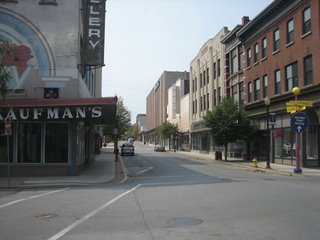 The Kaufman's store located on the left of the photos is not related to the Kaufmann's department store chain that is now part of Macy's empire and along with Hecht's lost its individual identity to the Macy's brand. Incidentally, the Kaufman's building no longer exists; it was demolished a year ago. The large brown-brick building in the distance at center was a huge department store named Gable's, which was the centerpiece of the downtown.
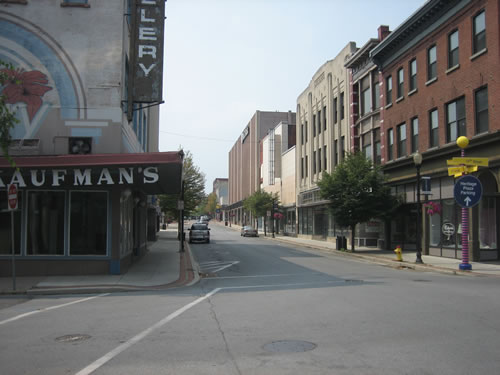 The Kaufman's store located on the left of the photos is not related to the Kaufmann's department store chain that is now part of Macy's empire and along with Hecht's lost its individual identity to the Macy's brand. Incidentally, the Kaufman's building no longer exists; it was demolished a year ago. The large brown-brick building in the distance at center was a huge department store named Gable's, which was the centerpiece of the downtown.
Altoona's downtown is one block from the railroad tracks. In the heyday of the Pennsylvania Rail Road, Altoona was an important stop, mainly as a center for car repair and engine building shops. There's a railroad museum across the tracks from the downtown, next to the more or less moribund Station Mall, a small one-story mall that never could compete with the larger Logan Valley Mall and perhaps never intended to, as it was anchored at its high point by a grocery store and a Hills Department Store (think of a K-Mart before they launched the Super K or Giant K or whatever). As with most rail towns, Altoona has seen its high mark receding into the distant past, but it clings furiously to the memory. The downtown is plastered with murals and posters depicting the glory that was the railroad.
The one above is an older one that was done while the downtown still had some shops and shoppers roaming around in it. As the downtown has become ever more desolate, the murals have become more ambitious, compensating for the fact that the lifestyle they allude to is gone forever, if it ever existed before anyway: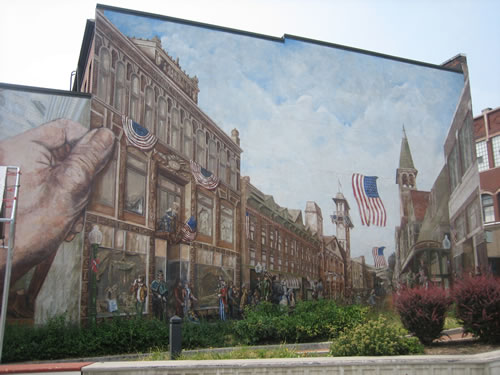
The downtown is currently full of empty storefronts with great historic (and some not so historic) bones. The train still stops twice a day -- once going east, once going west -- and the station -- which also doubles as the bus terminal -- is at least more permanent than the trailer that sat next to the tracks when my family boarded the train for an Arizona vacation in 1979.
09 October 2008
Who's writing the writing that will define our time?
Every now and then, a writer or writers come along who become representative for their time. Sometimes that designation fades, sometimes it doesn't. Sometimes the top authors of their time, authors whom everyone thought would be instantly eternalized as symbols of an era, fade into the out of print or at least obscure netherworld of the literary imagination.
I can think of a few writers in that latter category, like James T. Farrell. Farrell had a long and productive literary career that began and peaked in the 1930's. His Studs Lonigan Trilogy was required reading in college English courses in the 1950's and 1960's. These days, you probably won't find a Farrell book on the syllabus for anything other than an upper level or graduate course dedicated to the 1930's or Social Realism.
On the other hand, it's pretty easy to identify authors who have stuck evocatively to their times, at least after half a century has passed. F. Scott Fitzgerald comes to mind immediately. Jack Kerouac. Jane Austen. I'd argue for Steinbeck as well. This exercise could continue: Edith Wharton, E.M. Forster, Chucky Dickens.
It's immeasurably harder to identify these writers in our times, in part because it's harder to tell who will last and who will be a mere flash in the pan. It's also harder to tell because very few authors do get designated as top of the pile representatives of their time. Faulkner for instance remains an immensely respected author, but I would suspect that no one reads him because they identify him so closely with the 1920's or 1930's. Zora Neale Hurston's output doesn't establish her as the voice of the 1930's rural South either.
Again, this isn't about great writers, favorite authors, etc. It's about figuring out who has written the literature that will be understood in the future to be about the latest fin-de-siecle. I mean, I absolutely adore Jeanette Winterson's work, but will those texts be the touchstone for the late 1980's and 1990's UK?
So I'm asking, who is evoking our era (considered roughly as 1990-present, exceptions allowed) in ways that are not only extremely powerful now, but also likely to continue to retain that power for future generations?
I can think of a few writers in that latter category, like James T. Farrell. Farrell had a long and productive literary career that began and peaked in the 1930's. His Studs Lonigan Trilogy was required reading in college English courses in the 1950's and 1960's. These days, you probably won't find a Farrell book on the syllabus for anything other than an upper level or graduate course dedicated to the 1930's or Social Realism.
On the other hand, it's pretty easy to identify authors who have stuck evocatively to their times, at least after half a century has passed. F. Scott Fitzgerald comes to mind immediately. Jack Kerouac. Jane Austen. I'd argue for Steinbeck as well. This exercise could continue: Edith Wharton, E.M. Forster, Chucky Dickens.
It's immeasurably harder to identify these writers in our times, in part because it's harder to tell who will last and who will be a mere flash in the pan. It's also harder to tell because very few authors do get designated as top of the pile representatives of their time. Faulkner for instance remains an immensely respected author, but I would suspect that no one reads him because they identify him so closely with the 1920's or 1930's. Zora Neale Hurston's output doesn't establish her as the voice of the 1930's rural South either.
Again, this isn't about great writers, favorite authors, etc. It's about figuring out who has written the literature that will be understood in the future to be about the latest fin-de-siecle. I mean, I absolutely adore Jeanette Winterson's work, but will those texts be the touchstone for the late 1980's and 1990's UK?
So I'm asking, who is evoking our era (considered roughly as 1990-present, exceptions allowed) in ways that are not only extremely powerful now, but also likely to continue to retain that power for future generations?
11 September 2008
Perspective.
I don't generally post about the anniversary of September 11th, but I found myself thinking about it ever since I created my syllabus for the fall and found myself filling in a slot for Thursday, September 11th. I was teaching on that day in 2001 -- or rather would have been teaching that day, except classes were soon cancelled and justifiably so -- and there are two recurring images to me of that day that are purely personal: weaving my way through downtown traffic after picking up my son from day care and the small classroom in Corcoran Hall in which I would have been teaching.
It's really insignificant, isn't it? I think of that classroom and the students and that we were churning our way through early American literature at that point so early in the semester, having gotten through that dreadful Puritan crap (no offense to you early Americanists out there, really...someone has to be interested in that stuff) and we were in the midst of talking about the Revolutionary War era and those great products of the Enlightenment, Franklin and Paine.
Franklin, in his inimitable way, would have had a field day with our President repeating the mantra that the terrorists hated us "because of our freedom." Can you imagine Franklin, who in his day slyly ridiculed the religious right and slavery, sitting still while our supposed leaders perpetrated the worst kind of intellectual and moral laziness on the American public?
Paine, of course, became persona non grata in the United States after he decided that the same spirit of freedom that burst forth to fight for self-government would also be on the side of reason in the fight against superstition...but he was sadly mistaken...not too surprising for a country in which it's still common for athletes to think a supernatural entity is personally allowing them to score touchdowns.
I'm not going to lie: I thought then and still think now that the connecting thread of all American literature was the fact that we could do better -- that we weren't living up to our promises, our expectations, our ideals. Hope and disappointment run hand in hand through our best literature.
How can you read Souls of Black Folk and not see the investment in American ideals that Du Bois has alongside his bitter anger and disappointment that those ideals aren't much more than hollow words where race is concerned? The Great Gatsby is powerful because it shows how easily the American Dream is co-opted (for Nick) or misunderstood (for Gatsby)...boats against the current indeed. Russell Banks's Continental Drift, Whitman's Song of Myself, Emerson, Thoreau, Cather, even good old Cotton Mather. They all traffic in our contradictions and failures. They all say with Allen Ginsberg that there's still work to be done, they're putting their queer shoulders to the wheel.
I don't think you produce great art if you think we've arrived at perfection.
You don't get anywhere by refusing to ask questions.
Where does John Brown fit into all this?

It's really insignificant, isn't it? I think of that classroom and the students and that we were churning our way through early American literature at that point so early in the semester, having gotten through that dreadful Puritan crap (no offense to you early Americanists out there, really...someone has to be interested in that stuff) and we were in the midst of talking about the Revolutionary War era and those great products of the Enlightenment, Franklin and Paine.
Franklin, in his inimitable way, would have had a field day with our President repeating the mantra that the terrorists hated us "because of our freedom." Can you imagine Franklin, who in his day slyly ridiculed the religious right and slavery, sitting still while our supposed leaders perpetrated the worst kind of intellectual and moral laziness on the American public?
Paine, of course, became persona non grata in the United States after he decided that the same spirit of freedom that burst forth to fight for self-government would also be on the side of reason in the fight against superstition...but he was sadly mistaken...not too surprising for a country in which it's still common for athletes to think a supernatural entity is personally allowing them to score touchdowns.
I'm not going to lie: I thought then and still think now that the connecting thread of all American literature was the fact that we could do better -- that we weren't living up to our promises, our expectations, our ideals. Hope and disappointment run hand in hand through our best literature.
How can you read Souls of Black Folk and not see the investment in American ideals that Du Bois has alongside his bitter anger and disappointment that those ideals aren't much more than hollow words where race is concerned? The Great Gatsby is powerful because it shows how easily the American Dream is co-opted (for Nick) or misunderstood (for Gatsby)...boats against the current indeed. Russell Banks's Continental Drift, Whitman's Song of Myself, Emerson, Thoreau, Cather, even good old Cotton Mather. They all traffic in our contradictions and failures. They all say with Allen Ginsberg that there's still work to be done, they're putting their queer shoulders to the wheel.
I don't think you produce great art if you think we've arrived at perfection.
You don't get anywhere by refusing to ask questions.
Where does John Brown fit into all this?
13 August 2008
Dropping the veil.
My my my it's been a busy few weeks.
Let me let you in on a little secret.
I'm leaving the District of Columbia. Lighting out from the territories, if you will. To a bona fide state, or at least a commonwealth, and I'm not talking about that nasty place across the river.
When I first moved here in 1993, to the lush semi-suburbs of Woodley Park, I had no intention of staying a decade, let alone 15 years. Last year I had no intention (or at least prospects) of leaving. But chance rolls the dice.
I was a young lad then, not exactly strapping, but young nevertheless. I worked a night job at a university and trudged home winter nights after the Metro had closed and before I understood -- or cared to understand -- the bus system, stopping briefly at KramerBooks to browse the literature and philosophy sections as I warmed up for the big walk up the hill and over the Taft Bridge.
Then it was Logan Circle, where my roommate and I would watch the prostitutes chatting up the line of johns in their cars stretching down N Street by the all night gas station. That's when the Circle itself was nearly deserted except for the homeless and dealers and 14th Street's main features were the Black Cat and Barrel House Liquors.
Finally, I settled in Adams Morgan when I tell you -- and I kid you not -- a spacious two-bedroom with a beautiful westward view could be had for $850/mo utils incl... The Diner was an auto supply store, those red brick Adams Lofts, whose architecture I think was inspired by the Holocaust Museum, were nothing more than a surface parking lot, and Club Heaven was still playing some of the shittiest music ever recorded.
Let's give thanks for the good things...El Tamarindo, Astor Mediterranean, the recently departed San Marco (which beat the pants off Pasta Mia), The Common Share, Idle Times, DCCD, Crooked Beat, walking to the Zoo, biking anywhere else...
I suppose I could post a more general lamentation about the death of the District's independent and used bookstores...Kultura, Neil's, Vertigo, a basement place on U Street between 15th and 16th whose name escapes me now, Chapters (though they claim they're not closed...). Fortunately, we've still got Bridge Street Books, Idle Times, and Second Story.
Movie theatres, record stores...you know the run down. Hats off to the Biograph, the Key, the Janus, and the savior of all tight graduate student budgets, the Foundry.
OK.
Well, I'm not shutting down shop quite yet, but I'm not sure what the future brings.
Until next time...
Let me let you in on a little secret.
I'm leaving the District of Columbia. Lighting out from the territories, if you will. To a bona fide state, or at least a commonwealth, and I'm not talking about that nasty place across the river.
When I first moved here in 1993, to the lush semi-suburbs of Woodley Park, I had no intention of staying a decade, let alone 15 years. Last year I had no intention (or at least prospects) of leaving. But chance rolls the dice.
I was a young lad then, not exactly strapping, but young nevertheless. I worked a night job at a university and trudged home winter nights after the Metro had closed and before I understood -- or cared to understand -- the bus system, stopping briefly at KramerBooks to browse the literature and philosophy sections as I warmed up for the big walk up the hill and over the Taft Bridge.
Then it was Logan Circle, where my roommate and I would watch the prostitutes chatting up the line of johns in their cars stretching down N Street by the all night gas station. That's when the Circle itself was nearly deserted except for the homeless and dealers and 14th Street's main features were the Black Cat and Barrel House Liquors.
Finally, I settled in Adams Morgan when I tell you -- and I kid you not -- a spacious two-bedroom with a beautiful westward view could be had for $850/mo utils incl... The Diner was an auto supply store, those red brick Adams Lofts, whose architecture I think was inspired by the Holocaust Museum, were nothing more than a surface parking lot, and Club Heaven was still playing some of the shittiest music ever recorded.
Let's give thanks for the good things...El Tamarindo, Astor Mediterranean, the recently departed San Marco (which beat the pants off Pasta Mia), The Common Share, Idle Times, DCCD, Crooked Beat, walking to the Zoo, biking anywhere else...
I suppose I could post a more general lamentation about the death of the District's independent and used bookstores...Kultura, Neil's, Vertigo, a basement place on U Street between 15th and 16th whose name escapes me now, Chapters (though they claim they're not closed...). Fortunately, we've still got Bridge Street Books, Idle Times, and Second Story.
Movie theatres, record stores...you know the run down. Hats off to the Biograph, the Key, the Janus, and the savior of all tight graduate student budgets, the Foundry.
OK.
Well, I'm not shutting down shop quite yet, but I'm not sure what the future brings.
Until next time...
11 January 2008
Once again, the past keeps knock knock knocking at my door...
Let me tell you a story about my technical past. In college, I used the Macintosh computer labs, because the College of Education worked with Macs. In 1991, I received my first computer. It was a Mac Classic. Sometime around 1995 I bought a Mac PowerPC, and that was my computer until sometime around 2003, when I purchased a PC for the first time in my life.
What that means for me and you is that pretty much all of my graduate work was done on the Macintosh and remains on floppy disk. In fact, everything I did on computer was on Macintosh floppy disks, and has been nearly completely inaccessible for the past five or so years. I'm digging through those disks right now with the help of a program call MacOpener, trying to see if there's anything in my scholarly records salvageable and publishable with a little dusting off...
In the meantime I'm also finding that I've got quite a bit of poetry that I haven't seen in long time. So here's a little gem from the archive, circa 1995, from a period in which I must have been trying to write sonnets.
What that means for me and you is that pretty much all of my graduate work was done on the Macintosh and remains on floppy disk. In fact, everything I did on computer was on Macintosh floppy disks, and has been nearly completely inaccessible for the past five or so years. I'm digging through those disks right now with the help of a program call MacOpener, trying to see if there's anything in my scholarly records salvageable and publishable with a little dusting off...
In the meantime I'm also finding that I've got quite a bit of poetry that I haven't seen in long time. So here's a little gem from the archive, circa 1995, from a period in which I must have been trying to write sonnets.
Love and its attendants
Though you make tears flow in torrents
and fill my nights in dread dreams,
I pull myself to your side: quiet moments
with palms pressed or the unspoken need
of lips upon lips as the memory recedes
like a tide at its ebb. In wave's wake
the gulls walk stilted and pick tender meat
from stranded shells, the lonesome fate
of those who would leave the hidden deep
for a sunlit world, like those who expose
their soft bellies in the name of a dream.
I've seen vulture-cleaned bones in the glow
of moonlight, when the clouds split above,
and despite the terror, I will speak of love.
12 December 2007
Because in every boom the old rules don't apply.
Remember the tech boom? Remember how everyone (i.e. market analysts, industry shills) told us that in the New Economy, things like P/E ratios and actually making money didn't mean anything, because it was all new -- except apparently it wasn't, and when the house of cards collapsed people who hadn't been lucky enough to cash out on time were stuck holding stocks so worthless they might as well have papered the walls with them? But back then, it was all different, and things were never going to go back down...brilliantly asinine books came out with titles like Dow 4o,000...
Remember the housing boom? Oh that's right, we're sort of still in it -- we're on that precipice when the ground sort of starts downhill and then suddenly disappears. Everything changed then, too...houses weren't things you lived in, nice names for a necessity called shelter; no, they were investments, and despite the fact that you couldn't liquidate your investment without risking your shelter, people seemed to believe that the ATM machine called their homes would never run short of cash. We bought houses with interest only loans. We bought houses with ARMs that were only logical if you believed, against all logic, that interest rates would stay at historic lows forever.
But of course they would...because everything had changed.
Well, it's changed again. But we've known that for about a year and a half now, haven't we? It's just that the chickens, to borrow from Malcolm X, have come home to roost. Fairfax County, one of the wealthiest counties, now projects a $220 million shortfall tied to the housing crisis. Local builders are desperate. At least once a week I'm checking out Bubble Meter to follow the latest tidbits -- it's almost as good as a certain website tracking the tech collapse was back in the late 1990s (anyone remember the heyday of this site?). Housing Panic is also very good.
I'm convinced we are a lazy, complacent society that has little interest in examining ourselves. The whole of our culture is now disposable and meant to last no longer than our next paychecks. Even most otherwise intelligent adults have no interest in debating the merits of plans but are rather caught up in the latest fad, the latest "disposable policy," and the utterly unconvincing belief that we live ahistorically: that everything has changed.
Remember the housing boom? Oh that's right, we're sort of still in it -- we're on that precipice when the ground sort of starts downhill and then suddenly disappears. Everything changed then, too...houses weren't things you lived in, nice names for a necessity called shelter; no, they were investments, and despite the fact that you couldn't liquidate your investment without risking your shelter, people seemed to believe that the ATM machine called their homes would never run short of cash. We bought houses with interest only loans. We bought houses with ARMs that were only logical if you believed, against all logic, that interest rates would stay at historic lows forever.
But of course they would...because everything had changed.
Well, it's changed again. But we've known that for about a year and a half now, haven't we? It's just that the chickens, to borrow from Malcolm X, have come home to roost. Fairfax County, one of the wealthiest counties, now projects a $220 million shortfall tied to the housing crisis. Local builders are desperate. At least once a week I'm checking out Bubble Meter to follow the latest tidbits -- it's almost as good as a certain website tracking the tech collapse was back in the late 1990s (anyone remember the heyday of this site?). Housing Panic is also very good.
I'm convinced we are a lazy, complacent society that has little interest in examining ourselves. The whole of our culture is now disposable and meant to last no longer than our next paychecks. Even most otherwise intelligent adults have no interest in debating the merits of plans but are rather caught up in the latest fad, the latest "disposable policy," and the utterly unconvincing belief that we live ahistorically: that everything has changed.
11 December 2007
The lost years of our youth and the lost causes.
When I was a kid it seemed like forever between Thanksgiving and Christmas. That span of 30 days dragged on for at least 60, culminating in the delicious rush of Christmas Eve and Christmas, which was then followed by the sweet denoument of the lazy week between Christmas and New Years.
However, once you have kids, there's no such thing as time expanding between holidays -- time compresses until you no longer have 24 hours to yourself to do the shopping, wrapping, cooking, and cleaning necessary for the end of year festivities. And for all of those years (except for a year or two we skipped), my wife and I have also been jumping ship right after Christmas to head on our annual pilgrimage to the festival known as the MLA Conference.
This year in fact is doubly complicated (maybe triply...who knows) by the fact that both my wife and I are on the job market, a most depressing fact hammered home to us by every rejection letter that flutters in. The math is not particularly pretty: let's say an average job opening attracts 200 to 400 applicants (I'm not kidding). About ten will be selected for an interview at the MLA.
So already your chances are somewhere between 5 and 2.5 percent per job.
After the MLA interviews, generally three candidates will be invited to the campus for follow-up interviews. So even if you've made the first cut, the odds are once again against you for making the second cut.
But let's leave the campus visits aside for a time, since at this point I'm just angling for an interview. Just one, perhaps, to validate my 50+ applications. I've got one rejection in so far, but my wife has received around ten. Of course, she's also received one interview, so I think I would gladly take the ten rejections for one interview ratio myself.
The bottom line is that English Departments are incredibly disfunctional places (as any graduate student could probably tell you) where no one wants to do administrative work but where everyone likes to fight over whether administrative work is being done properly. So even if the deadline for the job announcement was November 1, chances are the committee hasn't even met to discuss the stack of applications they've received. Apocryphal stories concerning applicants being notified on Christmas Eve (Dec 24) about interviews at the MLA (beginning Dec 27th) abound, which is annoying for those people who would only go to the MLA if they had an interview.
I'm already going, so I don't care if they come grab me out of a panel to interview me. Just interview me.
However, once you have kids, there's no such thing as time expanding between holidays -- time compresses until you no longer have 24 hours to yourself to do the shopping, wrapping, cooking, and cleaning necessary for the end of year festivities. And for all of those years (except for a year or two we skipped), my wife and I have also been jumping ship right after Christmas to head on our annual pilgrimage to the festival known as the MLA Conference.
This year in fact is doubly complicated (maybe triply...who knows) by the fact that both my wife and I are on the job market, a most depressing fact hammered home to us by every rejection letter that flutters in. The math is not particularly pretty: let's say an average job opening attracts 200 to 400 applicants (I'm not kidding). About ten will be selected for an interview at the MLA.
So already your chances are somewhere between 5 and 2.5 percent per job.
After the MLA interviews, generally three candidates will be invited to the campus for follow-up interviews. So even if you've made the first cut, the odds are once again against you for making the second cut.
But let's leave the campus visits aside for a time, since at this point I'm just angling for an interview. Just one, perhaps, to validate my 50+ applications. I've got one rejection in so far, but my wife has received around ten. Of course, she's also received one interview, so I think I would gladly take the ten rejections for one interview ratio myself.
The bottom line is that English Departments are incredibly disfunctional places (as any graduate student could probably tell you) where no one wants to do administrative work but where everyone likes to fight over whether administrative work is being done properly. So even if the deadline for the job announcement was November 1, chances are the committee hasn't even met to discuss the stack of applications they've received. Apocryphal stories concerning applicants being notified on Christmas Eve (Dec 24) about interviews at the MLA (beginning Dec 27th) abound, which is annoying for those people who would only go to the MLA if they had an interview.
I'm already going, so I don't care if they come grab me out of a panel to interview me. Just interview me.
25 October 2007
Not gone, just missing.
Friends. Dear internet imaginary friends. Dear ghosts.
From Sunday until today I have been unusually sick. I have been to the doctors and the doctors (OK, to be accurate one doctor, one med student, one nurse, one radiation technician, and one lab tech who took blood) have told me it's some sort of viral infection. Get plenty of fluids. Get plenty of rest. Which I did. Normally, on sick days I can get plenty of my own stuff done -- read books, finish petty paperwork, straighten up the house, run errands -- but not this time around. About the only productive thing I managed to do for most of the time was watch one movie -- Almodovar's The Flower of My Secret -- and it was a nice diversion, so thank you NetFlix.
Yesterday I was still feeling ill, but by afternoon had recovered enough to get interested in this dusty stack of metal and wood and plastic in my basement. I hadn't messed with the guitars in a while, and in fact I'd forgotten just how damned beautiful the bass guitar that I've owned for twenty years is. So I took a picture of it. Check it out.

The picture really doesn't do it justice. It's a beautiful birdseye maple and quite solid. It's not for sale.
14 September 2007
There is nothing new under the sun.
It seems everywhere you look the 1980's are coming back with a vengeance. This phenomenon is not new. Back in the late 1990's, you could go to an "Eighties Dance Party" most nights in either Adams Morgan or downtown at some joint called Polly Esther's (or so I read in the City Paper). That initial bounce was generated by newly-minted drinking age patrons who were too young the first time around to remember how shitty most of that dreck was, so it was mainly a playlist dragged off the pop stations of the 1980's (at least in Adams Morgan, where I could hear "99 Red Ballons" from Heaven and Hell bouncing off the buildings and into our house every Thursday night; yeah, not even the German version, "Neunundneunzig Luftballoons").
This latest return is a bit different and manifests itself not so much in the music at crappy dance clubs, but in the throwback t-shirts of The Smiths and Siouxsie and the Banshees etc. visible on the now up and coming generation of (non-kickball playing) club-goers. Such bands were once a staple of 99.1 HFS, back when it was locally owned in the 1980's and early 1990's and long before it became a Spanish language station.
Which brings me rambling to another point: DC has no underground or offbeat radio station. Prior to the advent of the bastard genre called "alternative," which essentially became meaningless once it was formalized and formula-ized, HFS performed that crucial role in a city with many colleges but no college radio stations actually run by college students playing whatever the hell music said college students felt like playing. WHUR, WAMU, and WGBT are long gone (though they live on in other vestiges: WHUR and WAMU you probably recognize, and Georgetown donated its frequency, 90.1, to the newly formed UDC, which then sold it [!] to C-Span...).
I suppose you could argue that teh internets have brought back the idea of local programming (WGBT for instance has come back as an internet-only station), but until I can pick up webradio on my portable boom-box or my car radio (minus special satellite radio equipment), it isn't the same.
So if you've read this far, I'll let you in on a little slice of the 1980's that you'll not find on the dance floors but you can find at the Birchmere on October 22: Billy Bragg.
This latest return is a bit different and manifests itself not so much in the music at crappy dance clubs, but in the throwback t-shirts of The Smiths and Siouxsie and the Banshees etc. visible on the now up and coming generation of (non-kickball playing) club-goers. Such bands were once a staple of 99.1 HFS, back when it was locally owned in the 1980's and early 1990's and long before it became a Spanish language station.
Which brings me rambling to another point: DC has no underground or offbeat radio station. Prior to the advent of the bastard genre called "alternative," which essentially became meaningless once it was formalized and formula-ized, HFS performed that crucial role in a city with many colleges but no college radio stations actually run by college students playing whatever the hell music said college students felt like playing. WHUR, WAMU, and WGBT are long gone (though they live on in other vestiges: WHUR and WAMU you probably recognize, and Georgetown donated its frequency, 90.1, to the newly formed UDC, which then sold it [!] to C-Span...).
I suppose you could argue that teh internets have brought back the idea of local programming (WGBT for instance has come back as an internet-only station), but until I can pick up webradio on my portable boom-box or my car radio (minus special satellite radio equipment), it isn't the same.
So if you've read this far, I'll let you in on a little slice of the 1980's that you'll not find on the dance floors but you can find at the Birchmere on October 22: Billy Bragg.
30 August 2007
Name-checking bands.
Keeping on the music theme, I'm reminded of a time when my fellow English grad types sat around watching a baseball game. It was respectable back then for me to be considered a grad student, since after all I'd just completed coursework and we were all presumably working on our theses or dissertations...All of that circle, of course, had moved on by the millenium with their degrees to their "adult lives," leaving me and my wife floundering in ABD state. At that point, it's no longer pleasant to identify as a grad student.
But we were watching the Braves and whenever Chipper Jones went up to bat, the stadium PA system played Ozzy Osbourne's "Crazy Train," which of course got us thinking what our theme clips would be for when we entered conference rooms to give papers.
I settled on Guided by Voices's "Watch Me Jumpstart."
I think it's a good choice, which is a long-round way to get to talking about Guided by Voices, perhaps the finest band that ever did play in the 1990's (and I say that as a devoted follower of Pavement, at least up to and including Wowee Zowee...). There's something glorious about watching a band of 30 somethings, who had labored in their basements on this hobby, break it big (as Indie standards go), and proceed to combine the stage theatrics and heavy riffs of the 1970's arena rockers with the 1 and a half minute songs and low-fi techniques of the punk rockers.
Really, to watch Pollard perform, microphone dangling from one hand and an open Budweiser in the other, was brilliant. He treated every stage as if it were a stadium, doing Daltrey-esque microphone swings on cramped bar stages, which sometimes got him in trouble. I watched them open up for Superchunk in State College, PA, on a Halloween night in 1994 or 1995. The bar was a converted multi-level Burger King, and the stage was crammed into a back corner and resembled more or less a triangle. Think the old 9:30 Club, but smaller. Pollard was drunk off his ass, but that didn't stop him from trying his high leg kicks and microphone swinging, and on a few occasions he careened straight into the speaker stacks, running into Tobin Sprout a few times as well.
It was not a great musical performance, but it was one of those shows that built the "mystique" of GbV and a few years later, they're headlining the new 9:30 Club and playing for so long that the club finally turned the lights on to quell their act after about the fifth encore. I swear, the band would have kept playing until the Metro re-opened in the morning if the 9:30 Club would have allowed it.
And speaking of Superchunk, it's pretty damn hard to leave the albums On the Mouth and No Pocky for Kitty off a top 50 list of 1990's albums.
But we were watching the Braves and whenever Chipper Jones went up to bat, the stadium PA system played Ozzy Osbourne's "Crazy Train," which of course got us thinking what our theme clips would be for when we entered conference rooms to give papers.
I settled on Guided by Voices's "Watch Me Jumpstart."
I think it's a good choice, which is a long-round way to get to talking about Guided by Voices, perhaps the finest band that ever did play in the 1990's (and I say that as a devoted follower of Pavement, at least up to and including Wowee Zowee...). There's something glorious about watching a band of 30 somethings, who had labored in their basements on this hobby, break it big (as Indie standards go), and proceed to combine the stage theatrics and heavy riffs of the 1970's arena rockers with the 1 and a half minute songs and low-fi techniques of the punk rockers.
Really, to watch Pollard perform, microphone dangling from one hand and an open Budweiser in the other, was brilliant. He treated every stage as if it were a stadium, doing Daltrey-esque microphone swings on cramped bar stages, which sometimes got him in trouble. I watched them open up for Superchunk in State College, PA, on a Halloween night in 1994 or 1995. The bar was a converted multi-level Burger King, and the stage was crammed into a back corner and resembled more or less a triangle. Think the old 9:30 Club, but smaller. Pollard was drunk off his ass, but that didn't stop him from trying his high leg kicks and microphone swinging, and on a few occasions he careened straight into the speaker stacks, running into Tobin Sprout a few times as well.
It was not a great musical performance, but it was one of those shows that built the "mystique" of GbV and a few years later, they're headlining the new 9:30 Club and playing for so long that the club finally turned the lights on to quell their act after about the fifth encore. I swear, the band would have kept playing until the Metro re-opened in the morning if the 9:30 Club would have allowed it.
And speaking of Superchunk, it's pretty damn hard to leave the albums On the Mouth and No Pocky for Kitty off a top 50 list of 1990's albums.
15 August 2007
Thank you, NetFlix, from whom all blessings flow.
Dig on this.
In keeping with the Bill Murray theme, my wife and I watched Broken Flowers via our netflix supply line last night. It's Bill Murray playing that character he's perfected: detached, ironic, deadpan aging man unsure of his direction in life and behaving more as an observer than as an active participant in the world around him. It's also by Jim Jarmusch, which means you don't get a clear beginning, middle, and end with the handy Hollywood resolution. In fact, you get so little resolution that you marvel that it's an American film at all (then you see that it won the Grand Prix at Cannes in 2005 and suddenly things make more sense).
The plot is set in motion when Don Johnston (Bill Murray), a confirmed bachelor successfully retired from the computer industry and seemingly resolved to spend the rest of his days lying on his sofa watching television, receives a mysterious letter purporting to be from a former girlfriend twenty years in the past, in which the writer claims that they had a son together who at 19 years is now on a quest to find his father. The letter is brought to his attention by his current girlfriend (Julie Delphy), as she dumps him and walks out the door. His detective fiction loving neighbor, Winston, takes charge and dictates Johnston's actions that drive the movie forward. At Winston's urging, Johnston compiles a list of his girlfriends from that time, and Winston locates the four living ones (and the one dead one) and dispatches Johnston on a quest to visit each of the four and "look for clues" as to who wrote the letter.
It's brilliant. He visits each, with each encounter getting more uncomfortable and confrontational, culminating in his visit to Penny (Tilda Swinton). The cast of former flames is pretty impressive: Sharon Stone, Frances Conroy, Jessica Lange, and Tilda Swinton all in relatively short but emotionally charged roles (Julie Delphy, whose character dumps him at the beginning of the movie, is on screen for perhaps one minute).
The camera keeps playing tricks with the viewer, though, inserting repetitive images (for example, Johnston's drives to and from each encounter involve the road changing from interstate, to secondary highway, to backroad and vice versa) and ambiguous visual clues (he's been told to look for pink, since the letter writer used pink stationery: all of his ex-flames have several pink items around them).
By the end of the film, I was left thinking of The Crying of Lot 49 and some of the more interesting movies of the last decade that play with memory and perception, like Memento or Eternal Sunshine of the Spotless Mind. Although, more like the Pynchon novel than like the films, because in the end, you haven't unraveled anything.
In keeping with the Bill Murray theme, my wife and I watched Broken Flowers via our netflix supply line last night. It's Bill Murray playing that character he's perfected: detached, ironic, deadpan aging man unsure of his direction in life and behaving more as an observer than as an active participant in the world around him. It's also by Jim Jarmusch, which means you don't get a clear beginning, middle, and end with the handy Hollywood resolution. In fact, you get so little resolution that you marvel that it's an American film at all (then you see that it won the Grand Prix at Cannes in 2005 and suddenly things make more sense).
The plot is set in motion when Don Johnston (Bill Murray), a confirmed bachelor successfully retired from the computer industry and seemingly resolved to spend the rest of his days lying on his sofa watching television, receives a mysterious letter purporting to be from a former girlfriend twenty years in the past, in which the writer claims that they had a son together who at 19 years is now on a quest to find his father. The letter is brought to his attention by his current girlfriend (Julie Delphy), as she dumps him and walks out the door. His detective fiction loving neighbor, Winston, takes charge and dictates Johnston's actions that drive the movie forward. At Winston's urging, Johnston compiles a list of his girlfriends from that time, and Winston locates the four living ones (and the one dead one) and dispatches Johnston on a quest to visit each of the four and "look for clues" as to who wrote the letter.
It's brilliant. He visits each, with each encounter getting more uncomfortable and confrontational, culminating in his visit to Penny (Tilda Swinton). The cast of former flames is pretty impressive: Sharon Stone, Frances Conroy, Jessica Lange, and Tilda Swinton all in relatively short but emotionally charged roles (Julie Delphy, whose character dumps him at the beginning of the movie, is on screen for perhaps one minute).
The camera keeps playing tricks with the viewer, though, inserting repetitive images (for example, Johnston's drives to and from each encounter involve the road changing from interstate, to secondary highway, to backroad and vice versa) and ambiguous visual clues (he's been told to look for pink, since the letter writer used pink stationery: all of his ex-flames have several pink items around them).
By the end of the film, I was left thinking of The Crying of Lot 49 and some of the more interesting movies of the last decade that play with memory and perception, like Memento or Eternal Sunshine of the Spotless Mind. Although, more like the Pynchon novel than like the films, because in the end, you haven't unraveled anything.
01 May 2007
If my house were to catch fire, there's plenty of fuel.
Happy May Day to all!
I unearthed a whole folder full of horrifically embarrassing song lyrics that I wrote twenty years ago. Before I turned to poetry in my college years, I would write song lyrics obsessively, and I would date everything. Ostensibly, the lyrics were for the band my best friend and I hadn't yet formed, but by the time we'd graduated high school we'd actually recorded a few of them on a little four track recorder. I have no clue where any of that recorded material is, and my musical talents at that time were so primitive that I didn't play any of the instruments or sing on the recording. So my contribution in the studio -- aka my friend's bedroom -- was as lyricist.
Song lyrics are of course meant to be set to music, and they sound far better with a backing beat to take some attention away from the inanity of their content or the obviousness of their rhymes. There are of course exceptions; I think The Decemberists are incredibly inventive in the construction of their lyrics...I am in love with lines like "You come from parents wanton, childhood rough and rotten/I come from wealth and beauty, untouched by work or duty," from Picaresque's "We Both Go Down Together." Still, even their lyrics don't always scan well singled out from the music:
They aren't bad lyrics -- in fact, they're incredible with the music driving behind them, but standing alone they're kind of naked. The proper music behind something can transform the words from bland quatrains to overwhelming angst (see: Smashing Pumpkins).
Looking over my contributions to the field of song lyrics, I'm getting the feeling that pretty much any teenager who writes a journal/diary/poetry/lyrics can seem in retrospect like a pretty despondent and maladjusted loner. I don't exactly remember it that way, but I do think that teenagers, for better or worse, have a good bit of trouble turning off the immediacy of their emotions. It's everywhere, hence the Nirvana lyric, "Teenage angst has paid off well, now I'm old and gray." Or Bart Simpson's offhand remark, "Making a teenager depressed is like shooting fish in a barrel." So from 1-23-1986, I offer the following:
It's a sad thing to put your faith in the ceremony of the high school dance especially when you can't stand 85% of the music the DJ plays (and you can more or less guess the exact playlist for the entire year beforehand). I was the very definition of a wallflower. However, I do remember looking forward to going, if only because it was one of the few things to do in a small town on a weekend night.
I continued to write lyrics up until the early years of graduate school, at which point I ran out of spare time to sit around and play with words, and I often recorded them in a primitive way and having to sing the lyrics myself, a task I do not enjoy since my voice makes Bob Dylan, Neil Young, and Tom Waits sound like the Three Tenors (don't get me wrong: I love Bobby, Neil, and Tom). Which is to say that it remained an obsession and an outlet until replaced by other writings: the dissertation and this exercise I'm currently engaged in called blogging.
I unearthed a whole folder full of horrifically embarrassing song lyrics that I wrote twenty years ago. Before I turned to poetry in my college years, I would write song lyrics obsessively, and I would date everything. Ostensibly, the lyrics were for the band my best friend and I hadn't yet formed, but by the time we'd graduated high school we'd actually recorded a few of them on a little four track recorder. I have no clue where any of that recorded material is, and my musical talents at that time were so primitive that I didn't play any of the instruments or sing on the recording. So my contribution in the studio -- aka my friend's bedroom -- was as lyricist.
Song lyrics are of course meant to be set to music, and they sound far better with a backing beat to take some attention away from the inanity of their content or the obviousness of their rhymes. There are of course exceptions; I think The Decemberists are incredibly inventive in the construction of their lyrics...I am in love with lines like "You come from parents wanton, childhood rough and rotten/I come from wealth and beauty, untouched by work or duty," from Picaresque's "We Both Go Down Together." Still, even their lyrics don't always scan well singled out from the music:
Here on these cliffs of Dover
So high you can't see over
And while your head is spinning
Hold tight, it's just beginning
They aren't bad lyrics -- in fact, they're incredible with the music driving behind them, but standing alone they're kind of naked. The proper music behind something can transform the words from bland quatrains to overwhelming angst (see: Smashing Pumpkins).
Looking over my contributions to the field of song lyrics, I'm getting the feeling that pretty much any teenager who writes a journal/diary/poetry/lyrics can seem in retrospect like a pretty despondent and maladjusted loner. I don't exactly remember it that way, but I do think that teenagers, for better or worse, have a good bit of trouble turning off the immediacy of their emotions. It's everywhere, hence the Nirvana lyric, "Teenage angst has paid off well, now I'm old and gray." Or Bart Simpson's offhand remark, "Making a teenager depressed is like shooting fish in a barrel." So from 1-23-1986, I offer the following:
I've had too many chances
at too many dances
but the chances weren't right
I sat around all night
It's a sad thing to put your faith in the ceremony of the high school dance especially when you can't stand 85% of the music the DJ plays (and you can more or less guess the exact playlist for the entire year beforehand). I was the very definition of a wallflower. However, I do remember looking forward to going, if only because it was one of the few things to do in a small town on a weekend night.
I continued to write lyrics up until the early years of graduate school, at which point I ran out of spare time to sit around and play with words, and I often recorded them in a primitive way and having to sing the lyrics myself, a task I do not enjoy since my voice makes Bob Dylan, Neil Young, and Tom Waits sound like the Three Tenors (don't get me wrong: I love Bobby, Neil, and Tom). Which is to say that it remained an obsession and an outlet until replaced by other writings: the dissertation and this exercise I'm currently engaged in called blogging.
Subscribe to:
Posts (Atom)