I've been missing since the start of the fall semester 2010.
Sorry about that.
Or for some of you, sorry about coming back.
You might be curious as to what I've been doing in the intervening five months. Yeah, me too. The short story is that I was taking on too many projects at work and dedicating too much time to my hobbies such as playing guitar and wasting time on the internet.
I've been reading a lot of James Baldwin.
I've been living in exile from DC for over two years now, and it's really getting on my nerves. I am getting sick of pizza and wings and having to drive everywhere. I'm sick of oil furnaces. I'm sick of Confederate flags in this Union state. I'm sick of County governments and school boards that make DC officials look like Honest Abe.
I'm sick of Sarah Palin's bullshit and John Boehner's tan. I'm tired of the Tea Party. I want to believe our society has advanced somewhat in the last fifty years and I don't want to believe that the education system is so utterly broken that Fox News can fuel a mass movement.
I'm ready to scream in my little corner of cyberspace again.
Showing posts with label pondering life. Show all posts
Showing posts with label pondering life. Show all posts
17 January 2011

16 January 2011
Question to Ponder.
Is the USA still largely racist, or is it more likely that a predominant number of racists post comments on the Washington Post website?
30 June 2010
The rare pursuit of something called leisure reading.
Among the things I try to accomplish over the summer is to read some books that aren't in my area, as in books that I can't directly connect to any sort of "work reading." Since my area is American literature, I see anything written by an American as potential "work reading" -- and of course sometimes pleasure reading does double duty, such as the time I decided I wanted to read some Russell Banks.
However, more often than not, I try to go outside the United States. I'm currently reading Balzac's The Chouans. For me, at least, reading Balzac raises so many questions: I find myself taking breaks to look up information on the time (in this case, 1799) and place (Brittany), which of course leads on to biography of other figures and the French Revolution in general.
I've got several other books waiting for me, which is good, because I'm nearly done with this one. I haven't read any Jeanette Winterson in a long time (since The Powerbook, but I've read absolutely everything up to that point), so I might pick up her latest (not latest children's book -- and she's a very good children's novelist: I've read Tanglewreck), The Stone Gods, although the prospect of it possibly being science fiction doesn't excite me.
However, more often than not, I try to go outside the United States. I'm currently reading Balzac's The Chouans. For me, at least, reading Balzac raises so many questions: I find myself taking breaks to look up information on the time (in this case, 1799) and place (Brittany), which of course leads on to biography of other figures and the French Revolution in general.
I've got several other books waiting for me, which is good, because I'm nearly done with this one. I haven't read any Jeanette Winterson in a long time (since The Powerbook, but I've read absolutely everything up to that point), so I might pick up her latest (not latest children's book -- and she's a very good children's novelist: I've read Tanglewreck), The Stone Gods, although the prospect of it possibly being science fiction doesn't excite me.
05 January 2010
An overview of the past year.
2009 was not a stellar blogging year for me. Only one month did I manage double-digit posts, and two months I didn't post at all.
Here's the thing: I rarely missed it.
Sure, every now and then I would feel bad that I was neglecting the blog, but the main problem is that I've been out of touch with the District for too long.
It's not the so-called blogging community with their meet-ups and flame wars (I only met another blogger once, and that was by chance) that I've lost touch with, but the feel of place. My blog was mainly political, and much of that national, so it wasn't really a strict DC-living blog, but that's where the energy came from.
I'm not exactly shutting down the blog, at least officially. I might keep writing.
Who knows. There's so much disappointment everywhere.
Here's the thing: I rarely missed it.
Sure, every now and then I would feel bad that I was neglecting the blog, but the main problem is that I've been out of touch with the District for too long.
It's not the so-called blogging community with their meet-ups and flame wars (I only met another blogger once, and that was by chance) that I've lost touch with, but the feel of place. My blog was mainly political, and much of that national, so it wasn't really a strict DC-living blog, but that's where the energy came from.
I'm not exactly shutting down the blog, at least officially. I might keep writing.
Who knows. There's so much disappointment everywhere.
01 September 2009
California Dreaming.

These California fires are amazing, but like earthquakes, I think we out East consider them part and parcel of the California lifestyle. Yes, it's very sunny out there, but it's also a place for earthquakes and wildfires. The wildfire threat has grown mainly because so many remote areas are now subdivisions. As Americans, maybe as humans, we tend to disregard the power of nature and stretch our limits with little care for the long-term effects.
Not only California, but also the entire western United States, has seen massive population growth, with much of it occurring during a period in which the suburbs and then the exurbs were created and sprawl hadn't come to signify a long-term negative. The massive explosion of building around Las Vegas in the 1990's and early 2000's indicates that despite the lessons learned from half a century of sprawl in southern California, we still haven't learned that lesson.
In Chinatown, the plot revolves around the sinister possession of water rights in a thirsty LA that essentially gets its water from northern California. Phoenix, Las Vegas, and the massive LA metroplex all rely on the same water that farmers and fish rely on. As we push further into the hillsides and forests, we occupy land that is either subject to landslide or brush fire. So far we have water, earth, and fire. Maybe air is the Santa Ana winds.
We've essentially built a theme-park style dream of uninterrupted development, of perfectly landscaped cookie-cutter living boxes as deceptively laid out as any Disneyland. We turn on the tap and out comes water. We drive through the canyons and only encounter the occasional roadkill coyote or wandering scrub brush, and we convince ourselves that nature has been pacified.
In Ecology of Fear, which I have to revisit because it's been a long time, Mike Davis makes the argument that southern California is a disaster not only waiting to happen, but also already happening. He might push his point a bit far, but in general it's hard to argue with the thesis that hubristic overdevelopment has exposed us to a wrathful return of the repressed (to sneak a bit of Freud in), a reminder that we are not all.
18 August 2009
All the world's a stage.
Call me a simpleton, but I don't understand the connection between packing heat and health care. I've been to a lot of protests in my life -- anti-war, anti-corporate globalization, anti-xenophobia, pro-peace, pro-equal rights, etc. -- but I've never even thought it necessary to carry a gat, nor would I have seen a connection between any of these causes and my right to bear arms.
I suppose if you go back to the 1960's with the Black Panther Party for Self Defense you have the same sorts of images, but even in that case there are few parallels; after all, the Panthers were calling attention to the lack of protection they were getting from the government and the need for self-defense. They weren't protesting health care; in fact, they were often providing social welfare services.
The similarity in both cases, I suppose, is that the gun functions as a prop, a bit of costume. In the Panthers' case, it was to promote an image of strength and self-reliance in the face of nearly 400 years of racist oppression that at the moment seemed particularly virulent, what with assassinations of prominent Black figures and the mass murder of less-prominent blacks.
So in this more recent case, what's the prop represent?
I suppose if you go back to the 1960's with the Black Panther Party for Self Defense you have the same sorts of images, but even in that case there are few parallels; after all, the Panthers were calling attention to the lack of protection they were getting from the government and the need for self-defense. They weren't protesting health care; in fact, they were often providing social welfare services.
The similarity in both cases, I suppose, is that the gun functions as a prop, a bit of costume. In the Panthers' case, it was to promote an image of strength and self-reliance in the face of nearly 400 years of racist oppression that at the moment seemed particularly virulent, what with assassinations of prominent Black figures and the mass murder of less-prominent blacks.
So in this more recent case, what's the prop represent?
20 April 2009
I'm going where there's no depression.
I've been puzzling over the whole "Obama as Messiah" rhetoric I've been reading. I'm wondering where it started. What's the ur-text for the trope that goes under the name of Messiah, the Prophet, the One? It seems rather long-lasting for a bit of mud slung in a campaign that ended close to six months ago. Did it come out of disgruntled Hillary supporters? Did it come from disgruntled McCain supporters? Did it come from freepers?
I find it fascinating. I wonder if there's any history for this sort of demonization of President as false prophet or cult leader in the religious sense. I know with Reagan there was certainly a critique of the "actor as politician" charisma, but did it play out as religious fervor run amok? Perhaps a good place to look would be in the months following FDR's election. There are certainly similarities: a period of great financial upheaval following a long stretch of misrule, and a President with many plans for a new course.
It's fairly common of course for one side to see the other side's supporters as dupes of some kind, but it's the specifically religious aspect of this backlash that I'm interested in. I was thoroughly convinced in the summer leading up to the 2004 election that G.W. Bush wouldn't be in office come January 2005, given his already proven record of war crimes abroad and neglect at home. Sadly, I was wrong (thanks, Kerry). It never crossed my mind to think that anyone saw Bush as God, though. I figured his supporters were simply either stupid or protofascists (often the same thing) in the main.
The religious right, who sees the election of any Democrat as both a horrible event and a hopeful sign of the End Times, have long had the canned notion that the leader of a great nation (usually someone with faith in -- or at least the willingness to work with -- a world government like the UN) will rise up as the Antichrist, so I suppose for the really loonytune rightwingers Obama's just the latest in a line from Clinton and Carter who are eligible for that role. Still, the rhetoric is too pervasive for it to be the standard Tribulation Rap. Or maybe it's that the internet allows it to spread more virally. The last time a Democrat was elected on a platform of change was 1992, when social networking consisted of BBS and text-based email clients, so maybe the whole Messiah thing was there with Clinton and it just didn't get out beyond the remote armed compounds and John Birch Society meetings.
UPDATE: I was reading up on the Energy Crisis of the late 1970's and an article in The Progressive alluded to both Kennedy and Reagan's challenges to Carter's leadership as possible "new saviors," but the reference was fleeting and not an extended metaphor.
I find it fascinating. I wonder if there's any history for this sort of demonization of President as false prophet or cult leader in the religious sense. I know with Reagan there was certainly a critique of the "actor as politician" charisma, but did it play out as religious fervor run amok? Perhaps a good place to look would be in the months following FDR's election. There are certainly similarities: a period of great financial upheaval following a long stretch of misrule, and a President with many plans for a new course.
It's fairly common of course for one side to see the other side's supporters as dupes of some kind, but it's the specifically religious aspect of this backlash that I'm interested in. I was thoroughly convinced in the summer leading up to the 2004 election that G.W. Bush wouldn't be in office come January 2005, given his already proven record of war crimes abroad and neglect at home. Sadly, I was wrong (thanks, Kerry). It never crossed my mind to think that anyone saw Bush as God, though. I figured his supporters were simply either stupid or protofascists (often the same thing) in the main.
The religious right, who sees the election of any Democrat as both a horrible event and a hopeful sign of the End Times, have long had the canned notion that the leader of a great nation (usually someone with faith in -- or at least the willingness to work with -- a world government like the UN) will rise up as the Antichrist, so I suppose for the really loonytune rightwingers Obama's just the latest in a line from Clinton and Carter who are eligible for that role. Still, the rhetoric is too pervasive for it to be the standard Tribulation Rap. Or maybe it's that the internet allows it to spread more virally. The last time a Democrat was elected on a platform of change was 1992, when social networking consisted of BBS and text-based email clients, so maybe the whole Messiah thing was there with Clinton and it just didn't get out beyond the remote armed compounds and John Birch Society meetings.
UPDATE: I was reading up on the Energy Crisis of the late 1970's and an article in The Progressive alluded to both Kennedy and Reagan's challenges to Carter's leadership as possible "new saviors," but the reference was fleeting and not an extended metaphor.
23 March 2009
Lack of recognition.
Washington, DC, is many different towns, which sounds trite, but the most important aspect of that concept is that people outside of the District metropolitan area do not recognize DC as anything more than a symbol of the federal government.
In this world view, homes and neighborhoods don't really exist in DC. The District government is a joke, side show acts, like The Players in Hamlet, or maybe like the mock government some people played at in high school. People in DC work for the government, lobby the government, contract with the government, or don't work at all.
In part, it's not a terribly wrong impression, since DC so often becomes the plaything of itinerant powergrubbers who are completely unanswerable to the subjects on whom they conduct their experiments. However, it certainly passes over the lives of most residents of DC, who don't spend much of their time thinking about the federal government, or politics for that matter, except in the sense that everyone else in the US thinks about those things. Sure, it rankles to have no representation in Congress when you have a complaint or an issue, but it's not the sort of thing that creeps into your daily conscious state as you're trying to catch the L2 so you can hit the Safeway for groceries before it gets too late.
I should be thinking more about this bifurcated urban identity. The city as lived experience and the city as imagined space, in particular as tourist destination. London, New York, and Paris may be tourist destinations as well, but people talk about the experience of the cities. I don't know if people visiting DC think about it as a city so much as they think of it as a collection of monuments and museums.
In this world view, homes and neighborhoods don't really exist in DC. The District government is a joke, side show acts, like The Players in Hamlet, or maybe like the mock government some people played at in high school. People in DC work for the government, lobby the government, contract with the government, or don't work at all.
In part, it's not a terribly wrong impression, since DC so often becomes the plaything of itinerant powergrubbers who are completely unanswerable to the subjects on whom they conduct their experiments. However, it certainly passes over the lives of most residents of DC, who don't spend much of their time thinking about the federal government, or politics for that matter, except in the sense that everyone else in the US thinks about those things. Sure, it rankles to have no representation in Congress when you have a complaint or an issue, but it's not the sort of thing that creeps into your daily conscious state as you're trying to catch the L2 so you can hit the Safeway for groceries before it gets too late.
I should be thinking more about this bifurcated urban identity. The city as lived experience and the city as imagined space, in particular as tourist destination. London, New York, and Paris may be tourist destinations as well, but people talk about the experience of the cities. I don't know if people visiting DC think about it as a city so much as they think of it as a collection of monuments and museums.
08 January 2009
Crazy.
I still keep in touch with a large cadre of high school friends; it helps that many of us attended the same great university, Penn State, but it's also significant that many of these people I'd known since kindergarten or even pre-school.
Yesterday, the first of that group turned 40.
So begins the hit parade that runs through the spring...I'm next to go, then Feb 24, March 5, April 7, May 17...and into summer...June 14, August 24...bang, bang, bang down the line (several birthdates I don't even remember, too). Not a big deal, really. I mean, if you're 39 already, 40 is just another number. However, I can't help but look back on my life and I always latch onto a question a teacher asked the class back in the heady days of the late 1970's: "What will you be doing in the year 2000?"
The year 2000 was only a concept then. It was so far off to a nine year old's eyes, when even next Christmas seems a lifetime away. One thing I remember was that I thought, with a sense of how unreal it was, that I'd be over 30. An impossible vision.
Well, as Pink Floyd says, "One day you find, ten years have got behind you..." and here I am on the cusp of forty. I don't really measure my age anymore except in terms of my kids. How old will I be when my son's X, when my daughter's Y? I'll be nearing fifty when my son graduates high school. I'll be nearing fifty-five when my daughter does.
Crazy.
Yesterday, the first of that group turned 40.
So begins the hit parade that runs through the spring...I'm next to go, then Feb 24, March 5, April 7, May 17...and into summer...June 14, August 24...bang, bang, bang down the line (several birthdates I don't even remember, too). Not a big deal, really. I mean, if you're 39 already, 40 is just another number. However, I can't help but look back on my life and I always latch onto a question a teacher asked the class back in the heady days of the late 1970's: "What will you be doing in the year 2000?"
The year 2000 was only a concept then. It was so far off to a nine year old's eyes, when even next Christmas seems a lifetime away. One thing I remember was that I thought, with a sense of how unreal it was, that I'd be over 30. An impossible vision.
Well, as Pink Floyd says, "One day you find, ten years have got behind you..." and here I am on the cusp of forty. I don't really measure my age anymore except in terms of my kids. How old will I be when my son's X, when my daughter's Y? I'll be nearing fifty when my son graduates high school. I'll be nearing fifty-five when my daughter does.
Crazy.
01 December 2008
No rest for the weary.
We're into the frenzied days of December. As a child, I only worried about killing time until Christmas, and that wasn't hard to do, although the time between Thanksgiving and Christmas seemed an eternity. I'd come home from school -- the less planned hours of which generally included heavy loads of holiday crosswords or the perennial favorite, the old "see how many words you can make from 'Merry Christmas'" activity -- and it was time to lie under the artificial tree listening to Christmas music. On many days, my mother was baking something. There were always cookies.
Now, as an adult, there's simply no time between Thanksgiving and Christmas. Time isn't measured in hours or days, but in weekends. Since the post-Thanksgiving weekend is a wash, we're left with three weekends, and every weekend has a party invitation if not an acceptance, the semester ending papers and exams demand attention, those of us foolhardy enough to attend the MLA are planning not only a Christmas trip, but also a post-Christmas pre-New Year's itinerary, and we're well aware that when we return there's another semester waiting for prep. Throw children into the mix, and you're looking at one-twelfth of the year completely, utterly, irrevocably gone.
Happy holidays, everyone.
Now, as an adult, there's simply no time between Thanksgiving and Christmas. Time isn't measured in hours or days, but in weekends. Since the post-Thanksgiving weekend is a wash, we're left with three weekends, and every weekend has a party invitation if not an acceptance, the semester ending papers and exams demand attention, those of us foolhardy enough to attend the MLA are planning not only a Christmas trip, but also a post-Christmas pre-New Year's itinerary, and we're well aware that when we return there's another semester waiting for prep. Throw children into the mix, and you're looking at one-twelfth of the year completely, utterly, irrevocably gone.
Happy holidays, everyone.
04 November 2008
Multitudes.
So Walt Whitman, toward the end of Song of Myself, writes:
Do I contradict myself?
Very well then I contradict myself,
(I am large, I contain multitudes.)

Whitman has just given us an incredible portrait of an America that is and
also of an America that he wishes would be, so this admission near the poem's
completion describes both the nation and the narrative voice (which, let's face it, is Whitman, or at least his idea of himself -- the poem is also known as "Poem of Walt Whitman").
There's nonchalance in Whitman's understanding of contradiction: who cares, he says, that he may not be consistent...very little about life is. In that attitude he was joined by at least two of his contemporaries. Ralph Waldo Emerson opines that "a foolish consistency is the hobgoblin of little minds." Among other things, Emerson is arguing against those who value sticking to one's guns above re-evaluating and getting things right (like the idiot pictured on the link). Emerson and Whitman are joined by one of the foremost philosophers of the 19th century and a man hated by the far right (look up Eagle Forum and harmful books -- I don't like to link to fascists), Friedrich Nietzsche, though many attempts were made to co-opt him.
One of Nietzsche's aphorisms from Twilight of the Idols reads: "I mistrust all systematizers and I avoid them. The will to a system is a lack of integrity." The idea of a system is inextricably linked to closure: its laws must explain completely or the system is inadequate. Understood on a basic level, there are plenty of "gambling systems" available to Las Vegas aficionados, but to date, the casinos still rake in massive profits. Something obviously is escaping those systems.
So here we are on the day of election. Maybe Whitman is smiling amazed at the transformation in American society from his time to ours.
Or maybe he's simply saying it's about time.
22 October 2008
Archival quality.
I was reading an article in the Guardian about Doris Lessing recently turning over 113 letters to the University of East Anglia and I began thinking about how much of our literary biographies and indeed whole volumes of background material on authors relies upon that antiquated form of communication -- something permanent in its composition, but not mechanically transmitted and therefore not infinitely reproducible should the original be lost.
Very few people write letters today. Love letters, such as Lessing wrote to an RAF officer in her youth, are more likely to be text or instant messages these days. Letter writing as an activity was taken seriously; letters were cherished, stashed into drawers or boxes and saved in many cases long after the love affair or friendship ended; at the opposite extreme, letters were imbued with the emotional wreckage of poorly ended affairs, and their consumption by fire could prove cathartic.
To receive a letter from a friend or a loved one -- or even a publisher -- was a special event that consisted of more than a hello shout out. It brought local news and family updates in an age that didn't have the internet or cable television news and long distance was reserved for very special events. In artists' cases, it often brought news of current projects, artistic theories, attitudes on important social subjects of the day, etc., and that of course is what biographers and other scholars were interested in.
I wonder in our internet age, with communication as cheap as the time it takes to type a few terse sentences, if future generations will have access to the private thoughts of writers and other artists. On the one hand, the medium is ephemeral -- unless you take special steps, no hard copy of the document ever exists. On the other hand, the medium is more permanent than hand-written letters ever could be: on most systems the email is backed up and stored well beyond the individual user's ability to delete it. As more than one criminal has found out, deleting mail from the inbox and emptying the trash is not the equivalent of burning letters on the fire.
So copies exist. But unlike hardcopy handwritten letters, these copies don't fall to anyone upon the death of the author. Our email accounts as a general rule aren't enumerated among our estate's miscellaneous property. In fact, privacy concerns have led some companies to deny families access to the deceased person's email (though I don't know if the company in this particular case changed their position...).
In other words, the wealth of documentation -- as sheer quantity -- is most likely greater now than at any time in literacy's history. More written information is being passed on a daily basis by more people from all walks of life than ever before. IM's about going to the gym or to the grocery store; emails about upcoming weekend activities and chain letter forwarding. Electronically at least we have documented our lives in ways our predecessors never have.
I won't pass judgement on whether the quality of this documentation has increased or decreased. The key question is whether we will be able to get to that information.
Let's leave aside for now the question of identity and verifiability. Will authors begin donating their email archives to universities? Will the ephemera of instant chat sessions, which can of course be captured and saved as text files, fall into the hands of future biographers?
Very few people write letters today. Love letters, such as Lessing wrote to an RAF officer in her youth, are more likely to be text or instant messages these days. Letter writing as an activity was taken seriously; letters were cherished, stashed into drawers or boxes and saved in many cases long after the love affair or friendship ended; at the opposite extreme, letters were imbued with the emotional wreckage of poorly ended affairs, and their consumption by fire could prove cathartic.
To receive a letter from a friend or a loved one -- or even a publisher -- was a special event that consisted of more than a hello shout out. It brought local news and family updates in an age that didn't have the internet or cable television news and long distance was reserved for very special events. In artists' cases, it often brought news of current projects, artistic theories, attitudes on important social subjects of the day, etc., and that of course is what biographers and other scholars were interested in.
I wonder in our internet age, with communication as cheap as the time it takes to type a few terse sentences, if future generations will have access to the private thoughts of writers and other artists. On the one hand, the medium is ephemeral -- unless you take special steps, no hard copy of the document ever exists. On the other hand, the medium is more permanent than hand-written letters ever could be: on most systems the email is backed up and stored well beyond the individual user's ability to delete it. As more than one criminal has found out, deleting mail from the inbox and emptying the trash is not the equivalent of burning letters on the fire.
So copies exist. But unlike hardcopy handwritten letters, these copies don't fall to anyone upon the death of the author. Our email accounts as a general rule aren't enumerated among our estate's miscellaneous property. In fact, privacy concerns have led some companies to deny families access to the deceased person's email (though I don't know if the company in this particular case changed their position...).
In other words, the wealth of documentation -- as sheer quantity -- is most likely greater now than at any time in literacy's history. More written information is being passed on a daily basis by more people from all walks of life than ever before. IM's about going to the gym or to the grocery store; emails about upcoming weekend activities and chain letter forwarding. Electronically at least we have documented our lives in ways our predecessors never have.
I won't pass judgement on whether the quality of this documentation has increased or decreased. The key question is whether we will be able to get to that information.
Let's leave aside for now the question of identity and verifiability. Will authors begin donating their email archives to universities? Will the ephemera of instant chat sessions, which can of course be captured and saved as text files, fall into the hands of future biographers?
11 September 2008
Perspective.
I don't generally post about the anniversary of September 11th, but I found myself thinking about it ever since I created my syllabus for the fall and found myself filling in a slot for Thursday, September 11th. I was teaching on that day in 2001 -- or rather would have been teaching that day, except classes were soon cancelled and justifiably so -- and there are two recurring images to me of that day that are purely personal: weaving my way through downtown traffic after picking up my son from day care and the small classroom in Corcoran Hall in which I would have been teaching.
It's really insignificant, isn't it? I think of that classroom and the students and that we were churning our way through early American literature at that point so early in the semester, having gotten through that dreadful Puritan crap (no offense to you early Americanists out there, really...someone has to be interested in that stuff) and we were in the midst of talking about the Revolutionary War era and those great products of the Enlightenment, Franklin and Paine.
Franklin, in his inimitable way, would have had a field day with our President repeating the mantra that the terrorists hated us "because of our freedom." Can you imagine Franklin, who in his day slyly ridiculed the religious right and slavery, sitting still while our supposed leaders perpetrated the worst kind of intellectual and moral laziness on the American public?
Paine, of course, became persona non grata in the United States after he decided that the same spirit of freedom that burst forth to fight for self-government would also be on the side of reason in the fight against superstition...but he was sadly mistaken...not too surprising for a country in which it's still common for athletes to think a supernatural entity is personally allowing them to score touchdowns.
I'm not going to lie: I thought then and still think now that the connecting thread of all American literature was the fact that we could do better -- that we weren't living up to our promises, our expectations, our ideals. Hope and disappointment run hand in hand through our best literature.
How can you read Souls of Black Folk and not see the investment in American ideals that Du Bois has alongside his bitter anger and disappointment that those ideals aren't much more than hollow words where race is concerned? The Great Gatsby is powerful because it shows how easily the American Dream is co-opted (for Nick) or misunderstood (for Gatsby)...boats against the current indeed. Russell Banks's Continental Drift, Whitman's Song of Myself, Emerson, Thoreau, Cather, even good old Cotton Mather. They all traffic in our contradictions and failures. They all say with Allen Ginsberg that there's still work to be done, they're putting their queer shoulders to the wheel.
I don't think you produce great art if you think we've arrived at perfection.
You don't get anywhere by refusing to ask questions.
Where does John Brown fit into all this?

It's really insignificant, isn't it? I think of that classroom and the students and that we were churning our way through early American literature at that point so early in the semester, having gotten through that dreadful Puritan crap (no offense to you early Americanists out there, really...someone has to be interested in that stuff) and we were in the midst of talking about the Revolutionary War era and those great products of the Enlightenment, Franklin and Paine.
Franklin, in his inimitable way, would have had a field day with our President repeating the mantra that the terrorists hated us "because of our freedom." Can you imagine Franklin, who in his day slyly ridiculed the religious right and slavery, sitting still while our supposed leaders perpetrated the worst kind of intellectual and moral laziness on the American public?
Paine, of course, became persona non grata in the United States after he decided that the same spirit of freedom that burst forth to fight for self-government would also be on the side of reason in the fight against superstition...but he was sadly mistaken...not too surprising for a country in which it's still common for athletes to think a supernatural entity is personally allowing them to score touchdowns.
I'm not going to lie: I thought then and still think now that the connecting thread of all American literature was the fact that we could do better -- that we weren't living up to our promises, our expectations, our ideals. Hope and disappointment run hand in hand through our best literature.
How can you read Souls of Black Folk and not see the investment in American ideals that Du Bois has alongside his bitter anger and disappointment that those ideals aren't much more than hollow words where race is concerned? The Great Gatsby is powerful because it shows how easily the American Dream is co-opted (for Nick) or misunderstood (for Gatsby)...boats against the current indeed. Russell Banks's Continental Drift, Whitman's Song of Myself, Emerson, Thoreau, Cather, even good old Cotton Mather. They all traffic in our contradictions and failures. They all say with Allen Ginsberg that there's still work to be done, they're putting their queer shoulders to the wheel.
I don't think you produce great art if you think we've arrived at perfection.
You don't get anywhere by refusing to ask questions.
Where does John Brown fit into all this?
13 March 2008
Three things I've learned the hard way.
Thanks to Lonnie Bruner for tagging me on this one. Of course, he did that back in February, and here we are nearly to the Ides of March and I'm finally catching up. Learning things the hard way is often the only way to learn some lessons, because they simply don't sink in properly until the time for recovery is past.
1. Sit your ass in the chair and just write. Seriously. You will not finish your dissertation/novel/autobiography as long as you continue to do "research." You simply can't know it all, and besides, you will never end up going where you think you were going in the beginning. Only the writing will tell. It took me seven years to figure that out.
2. You are only young once. Apparently as you age, your bones aren't as resilient and things like tendons, muscles, and joints fail with disappointing ease. While I've learned this lesson quite often over the past few years, it's a teaching I have mostly ignored as far as basketball is concerned. So maybe you could say I haven't learned it the hard way yet, with the hard way meaning a broken leg or jaw. Maybe. I have broken my ankle, though. And then sprained it severely a few months later. The sprain was worse.
3. Don't do crack; it's a ghetto drug. Um, OK, that was a lesson from Bob Roberts. Never mind.
3. You should never, ever try to apply rational arguments to middle-school disputes. In middle-school, you only look like a fool trying to explain or analyze situations. As Homer Simpson argues, the "law of the playground" rules the day, and fists speak louder than words. However, you can still talk your way out of a fight if you claim that "My mother told me never to throw the first punch. Just the last one."
1. Sit your ass in the chair and just write. Seriously. You will not finish your dissertation/novel/autobiography as long as you continue to do "research." You simply can't know it all, and besides, you will never end up going where you think you were going in the beginning. Only the writing will tell. It took me seven years to figure that out.
2. You are only young once. Apparently as you age, your bones aren't as resilient and things like tendons, muscles, and joints fail with disappointing ease. While I've learned this lesson quite often over the past few years, it's a teaching I have mostly ignored as far as basketball is concerned. So maybe you could say I haven't learned it the hard way yet, with the hard way meaning a broken leg or jaw. Maybe. I have broken my ankle, though. And then sprained it severely a few months later. The sprain was worse.
3. Don't do crack; it's a ghetto drug. Um, OK, that was a lesson from Bob Roberts. Never mind.
3. You should never, ever try to apply rational arguments to middle-school disputes. In middle-school, you only look like a fool trying to explain or analyze situations. As Homer Simpson argues, the "law of the playground" rules the day, and fists speak louder than words. However, you can still talk your way out of a fight if you claim that "My mother told me never to throw the first punch. Just the last one."
12 February 2008
Untimely meditations.
I wonder about the future of literacy.
Democracy assumes both equal access to all and an informed electorate -- for instance, theoretically one should know about the candidates in a given race prior to voting, or be somewhat apprised of the issues of a referendum that might be on the ballot. Obviously, equal access is a bit easier to enforce than informed electorate.
For some strange reason, I feel that literacy is tied to an informed electorate. Maybe I'm being idealistic, but I'd like to think that being able to read Hegel or Emerson or Dewey should be a skill more wide-spread through our society. For one thing, it would knock morons like Thomas Friedman and George Will off the editorial pages, because a populace that could make sense of Emerson's "The American Scholar" (for instance) wouldn't stand for two minutes the sort of mushy thinking those two goons spout.
Literacy isn't simply the ability to read. Most first graders can read words on a page and figure out simple directives like "Employees must wash hands before returning to work." (and here again, literacy doesn't necessarily have anything to do with following those directives...) Literacy involves critical thinking skills because it requires us to make meaning of the words we've read -- an always imperfect task, but one which even Derrida argues is a necessary task.
I suppose much of my worrying is due to the reach of technology into our leisure time: just as recorded music more or less killed family musical recitals as a form of popular entertainment, so too will Guitar Hero, Nintendo DS, and Virtual Worlds kill what little time remains to our thoughts after cable television carved out its chunk.
Am I sounding too Frankfurt School?
Maybe I'm just getting old.
Democracy assumes both equal access to all and an informed electorate -- for instance, theoretically one should know about the candidates in a given race prior to voting, or be somewhat apprised of the issues of a referendum that might be on the ballot. Obviously, equal access is a bit easier to enforce than informed electorate.
For some strange reason, I feel that literacy is tied to an informed electorate. Maybe I'm being idealistic, but I'd like to think that being able to read Hegel or Emerson or Dewey should be a skill more wide-spread through our society. For one thing, it would knock morons like Thomas Friedman and George Will off the editorial pages, because a populace that could make sense of Emerson's "The American Scholar" (for instance) wouldn't stand for two minutes the sort of mushy thinking those two goons spout.
Literacy isn't simply the ability to read. Most first graders can read words on a page and figure out simple directives like "Employees must wash hands before returning to work." (and here again, literacy doesn't necessarily have anything to do with following those directives...) Literacy involves critical thinking skills because it requires us to make meaning of the words we've read -- an always imperfect task, but one which even Derrida argues is a necessary task.
I suppose much of my worrying is due to the reach of technology into our leisure time: just as recorded music more or less killed family musical recitals as a form of popular entertainment, so too will Guitar Hero, Nintendo DS, and Virtual Worlds kill what little time remains to our thoughts after cable television carved out its chunk.
Am I sounding too Frankfurt School?
Maybe I'm just getting old.
07 February 2008
One World Is Enough for All of Us...
"Virtual reality, the reality that might be said to be perfectly homogenized,
digitized and 'operationalized,' substitutes for the other [the "real" world]
because it is perfect, verifiable and non-contradictory. So, because it is more
'complete,' it is more real than what we have established as simulacrum."
[Baudrillard, Passwords 39]
It's important to understand that for Baudrillard there is no real world, no accessible, verifiable reality in the sense of concrete fact: it's all layered interpretations. But that's not really all that new, since Nietzsche argued similarly way back in the late nineteenth century. So what we've "established as simulacrum" is what most of us call the "real world." However, since it's so built on perception and interpretation, it leaves holes and inconsistencies, and that's where virtual reality comes in to save us -- it has rules programmed straight into it, and those rules don't change. Hence Cube's story of the Sims Reign of Terror.
It's important for the players to know that the game is fair, that the inequalities and indignations of their real lives can be leveled by the program running behind the GUI in their virtual worlds. My avatar can be the right height and weight, even if I'm not. It's like existentialism gone horribly wrong: instead of the despair I'm supposed to feel in being condemned to be free, I seize upon my freedom to remake myself in every aspect -- I'm a suave urbane ladies man with a nice car and well-appointed apartment. Why not?
Are we more like ourselves as we want to be when we're in our Second Life? We already know that the [relative, assumed, and imperfect] anonymity of the internet allows us to be nasty to perfect strangers, perhaps proof nearly a century later of Freud's major thesis in Civilization and Its Discontents that society's real problem is that it's built on a trade-off between freedom and safety that as human organisms we've never fully accepted.
Are we more free in the online world, or does that assumed freedom simply remind us of how constrained we are in our offline lives?
12 December 2007
Because in every boom the old rules don't apply.
Remember the tech boom? Remember how everyone (i.e. market analysts, industry shills) told us that in the New Economy, things like P/E ratios and actually making money didn't mean anything, because it was all new -- except apparently it wasn't, and when the house of cards collapsed people who hadn't been lucky enough to cash out on time were stuck holding stocks so worthless they might as well have papered the walls with them? But back then, it was all different, and things were never going to go back down...brilliantly asinine books came out with titles like Dow 4o,000...
Remember the housing boom? Oh that's right, we're sort of still in it -- we're on that precipice when the ground sort of starts downhill and then suddenly disappears. Everything changed then, too...houses weren't things you lived in, nice names for a necessity called shelter; no, they were investments, and despite the fact that you couldn't liquidate your investment without risking your shelter, people seemed to believe that the ATM machine called their homes would never run short of cash. We bought houses with interest only loans. We bought houses with ARMs that were only logical if you believed, against all logic, that interest rates would stay at historic lows forever.
But of course they would...because everything had changed.
Well, it's changed again. But we've known that for about a year and a half now, haven't we? It's just that the chickens, to borrow from Malcolm X, have come home to roost. Fairfax County, one of the wealthiest counties, now projects a $220 million shortfall tied to the housing crisis. Local builders are desperate. At least once a week I'm checking out Bubble Meter to follow the latest tidbits -- it's almost as good as a certain website tracking the tech collapse was back in the late 1990s (anyone remember the heyday of this site?). Housing Panic is also very good.
I'm convinced we are a lazy, complacent society that has little interest in examining ourselves. The whole of our culture is now disposable and meant to last no longer than our next paychecks. Even most otherwise intelligent adults have no interest in debating the merits of plans but are rather caught up in the latest fad, the latest "disposable policy," and the utterly unconvincing belief that we live ahistorically: that everything has changed.
Remember the housing boom? Oh that's right, we're sort of still in it -- we're on that precipice when the ground sort of starts downhill and then suddenly disappears. Everything changed then, too...houses weren't things you lived in, nice names for a necessity called shelter; no, they were investments, and despite the fact that you couldn't liquidate your investment without risking your shelter, people seemed to believe that the ATM machine called their homes would never run short of cash. We bought houses with interest only loans. We bought houses with ARMs that were only logical if you believed, against all logic, that interest rates would stay at historic lows forever.
But of course they would...because everything had changed.
Well, it's changed again. But we've known that for about a year and a half now, haven't we? It's just that the chickens, to borrow from Malcolm X, have come home to roost. Fairfax County, one of the wealthiest counties, now projects a $220 million shortfall tied to the housing crisis. Local builders are desperate. At least once a week I'm checking out Bubble Meter to follow the latest tidbits -- it's almost as good as a certain website tracking the tech collapse was back in the late 1990s (anyone remember the heyday of this site?). Housing Panic is also very good.
I'm convinced we are a lazy, complacent society that has little interest in examining ourselves. The whole of our culture is now disposable and meant to last no longer than our next paychecks. Even most otherwise intelligent adults have no interest in debating the merits of plans but are rather caught up in the latest fad, the latest "disposable policy," and the utterly unconvincing belief that we live ahistorically: that everything has changed.
26 November 2007
As if Sudan didn't have enough problems...
Sure we aren't out of the woods yet and there's still a lot of nutcases out there who want to burn witches for teaching evolution, but at least in the USA you don't get arrested and have your school shut down because some first graders named their class's stuffed animal "Muhammad.":
I'm entertaining reasonable suggestions for why religion dominates Muslim countries the way it does (and yeah I know the whole thing about graven images and blah blah blah...I'm asking for reasonable suggestions).
The BBC's correspondent Amber Henshaw said Ms Gibbons' punishment could be up to six months in jail, 40 lashes or a fine.Seriously, how f'ed up is a country when a first grade teacher is in danger of being lynched over the name of a teddy bear? Reminds me of the scene in Monty Python's The Life of Brian where the man's getting stoned to death for saying the name "Jehovah."
The school has been closed until January for fear of reprisals.
Fellow teachers at Khartoum's Unity High School told Reuters news agency they feared for Ms Gibbons' safety after receiving reports that men had started gathering outside the police station where she was being held.
I'm entertaining reasonable suggestions for why religion dominates Muslim countries the way it does (and yeah I know the whole thing about graven images and blah blah blah...I'm asking for reasonable suggestions).
08 November 2007
Milestones.
A friend of mine, his father just died. It seems to be a year of that, with three of my close friends now losing their fathers this year. The first came after a long six month decline, and to tell you the truth I didn't know how to react. I'd known the man, played poker with him. He'd been a fixture at our summer league basketball games. But to be quite honest, I froze up. Outside of a phone call, I did nothing.
The second friend's father had been much older and in a state of precarious health. I saw her soon afterwards and had more time to talk with her about the death, but still I feel I didn't do all I could or perhaps what I should.
The third friend, who happens to be married to the second friend, both of whom I've known since freshmen in college, just lost his father a week and a half ago. So their family has had a rough year. In this case, at least, I'll be able to attend the memorial service in northern New Jersey.
Let's hope I get things right.
The second friend's father had been much older and in a state of precarious health. I saw her soon afterwards and had more time to talk with her about the death, but still I feel I didn't do all I could or perhaps what I should.
The third friend, who happens to be married to the second friend, both of whom I've known since freshmen in college, just lost his father a week and a half ago. So their family has had a rough year. In this case, at least, I'll be able to attend the memorial service in northern New Jersey.
Let's hope I get things right.
17 October 2007
A judgement call.
Please identify the racist stereotypes in the photos below:
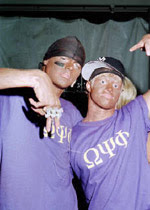


The team from Cleveland is of course long-suffering and it looks like they're finally headed to the World Series, where they will hopefully knock the stuffing out of the Colorado Rockies, but maybe it's time to give that mascot a rest.


The team from Cleveland is of course long-suffering and it looks like they're finally headed to the World Series, where they will hopefully knock the stuffing out of the Colorado Rockies, but maybe it's time to give that mascot a rest.
Subscribe to:
Posts (Atom)